A sample service blueprint shows what a definition cannot: which lanes a real encounter needs, and where its weak points sit. Five follow, each read a different way. Every card, stage name and owner quoted from the three starters is copied word for word from its file.
Three of the five ship as starters you can open: a bike repair, a support case and a new hire's first quarter. A hotel stay and a restaurant meal have none, so those sections name the starter to adapt and the lane to add. The blueprint how-to reads one column of the bike repair. This page reads along the lanes and across the line instead.
A bike repair, read along the Backstage lane
The service blueprint starter follows one same-day repair through Aware, Enter, Engage, Exit and Follow-up. Leave the customer's row alone for now and read only the third lane, left to right. Its owners are Operations, Service desk, Workshop, Workshop lead and Operations again.
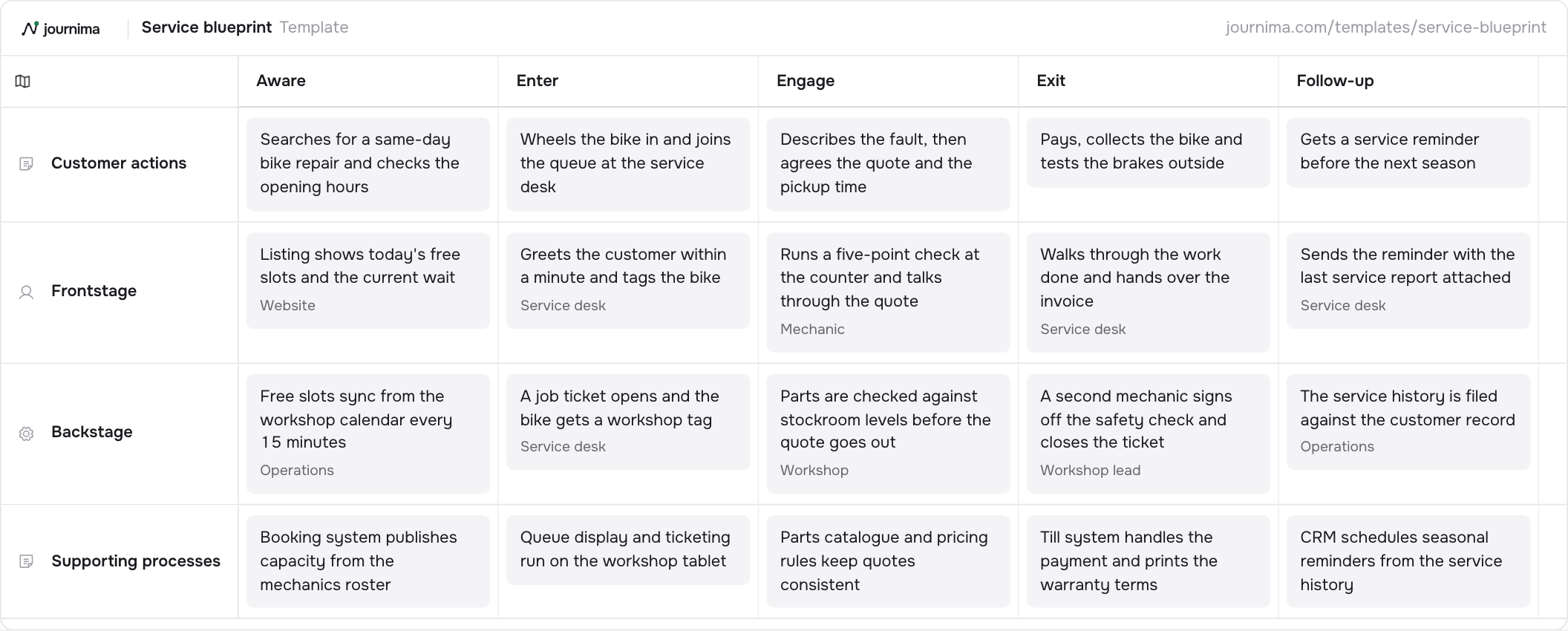
Every change of owner is a handover, so this lane holds four of them in five cards. For each one, ask what travels with the job. Inside the shop it is the ticket. The service desk opens it at Enter, and at Exit the workshop lead's card reads "A second mechanic signs off the safety check and closes the ticket".
Operations owns both ends, and never touches the bike. At Aware it owns a calendar feed. At Follow-up it owns a record: "The service history is filed against the customer record". That last handover is the one to question. The CRM schedules the reminder from that history, and it goes out "with the last service report attached". Whatever the history leaves out, the customer finds missing next season.
Now look up from the lane. Two promises above the line lean on a card in it.
- Aware. The website shows "today's free slots and the current wait". The card beneath it reads "Free slots sync from the workshop calendar every 15 minutes". The listing can trail the workshop by a quarter of an hour. A customer who rides over for a slot that has just gone arrives at Enter already let down.
- Exit. The service desk "Walks through the work done and hands over the invoice". It can only do that honestly once a second mechanic has signed off. If the sign-off runs late, the desk either keeps the customer waiting or explains work nobody has checked yet.
Neither promise is wrong. Each is exactly as good as the card under it, and reading along the lane is how you find that card.
A support case: a blueprint with a clock and a curve
The support and complaint starter is not called a blueprint, but it is one. Front line and Behind the scenes are the Frontstage and Backstage lane types under other names. It also carries two lanes the bike repair lacks: Channels above them, and an Emotion curve at the bottom.
The encounter opens at Issue occurs, on the customer's card "Payment fails twice and the order never confirms". It runs through Contact, Triage and Resolution to Follow-up.
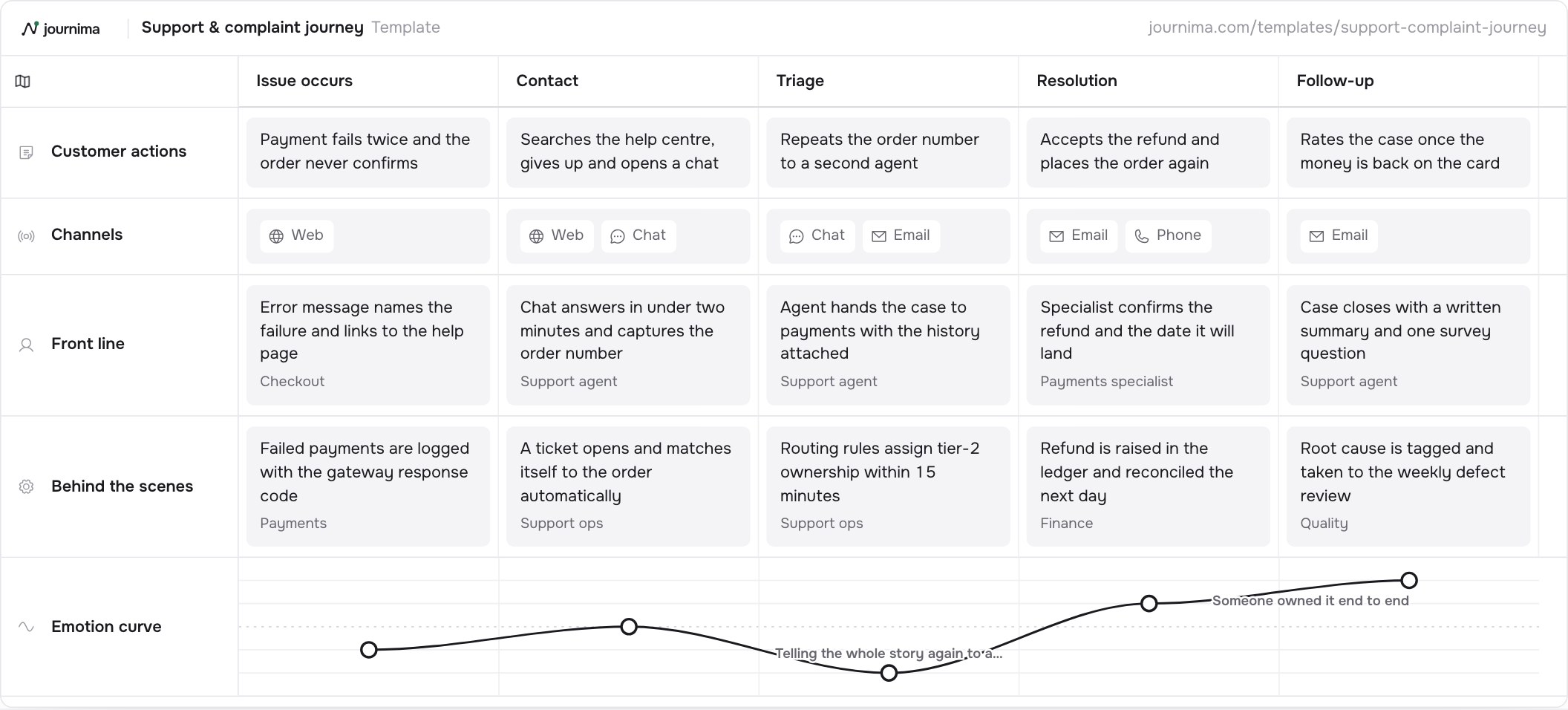
Three cards carry a clock. On the Front line at Contact, "Chat answers in under two minutes and captures the order number". Behind the scenes at Triage, "Routing rules assign tier-2 ownership within 15 minutes". At Resolution, "Refund is raised in the ledger and reconciled the next day". The clock above the line is under two minutes. The two below it run to a quarter of an hour at Triage and a day at Resolution.
Now lay the curve over them. It does not follow the clock. The fastest promise behind the scenes lines up with the lowest score, minus two at Triage, for the reason the claims example gives. The slowest lines up with plus one at Resolution, where the Front line card reads "Specialist confirms the refund and the date it will land". A slow step below the line can cost little on the curve when the card above it names a date.
The ending is where the two halves part. The customer "Rates the case once the money is back on the card", and the curve reaches plus two with the note "Someone owned it end to end". Behind the scenes, Quality is still at work: "Root cause is tagged and taken to the weekly defect review". For the customer the encounter stops at the rating. For the service it stops at that review, the one card that protects the next customer, and the curve cannot see it.
Employee onboarding as an internal service blueprint
Onboarding is a service whose customer is on the payroll. The starter runs from Offer through First day, First week and First month to First quarter, where "Probation review is booked and the goals are written down". Its one service lane, HR & manager actions, is a Backstage lane: the type for work behind the scenes.
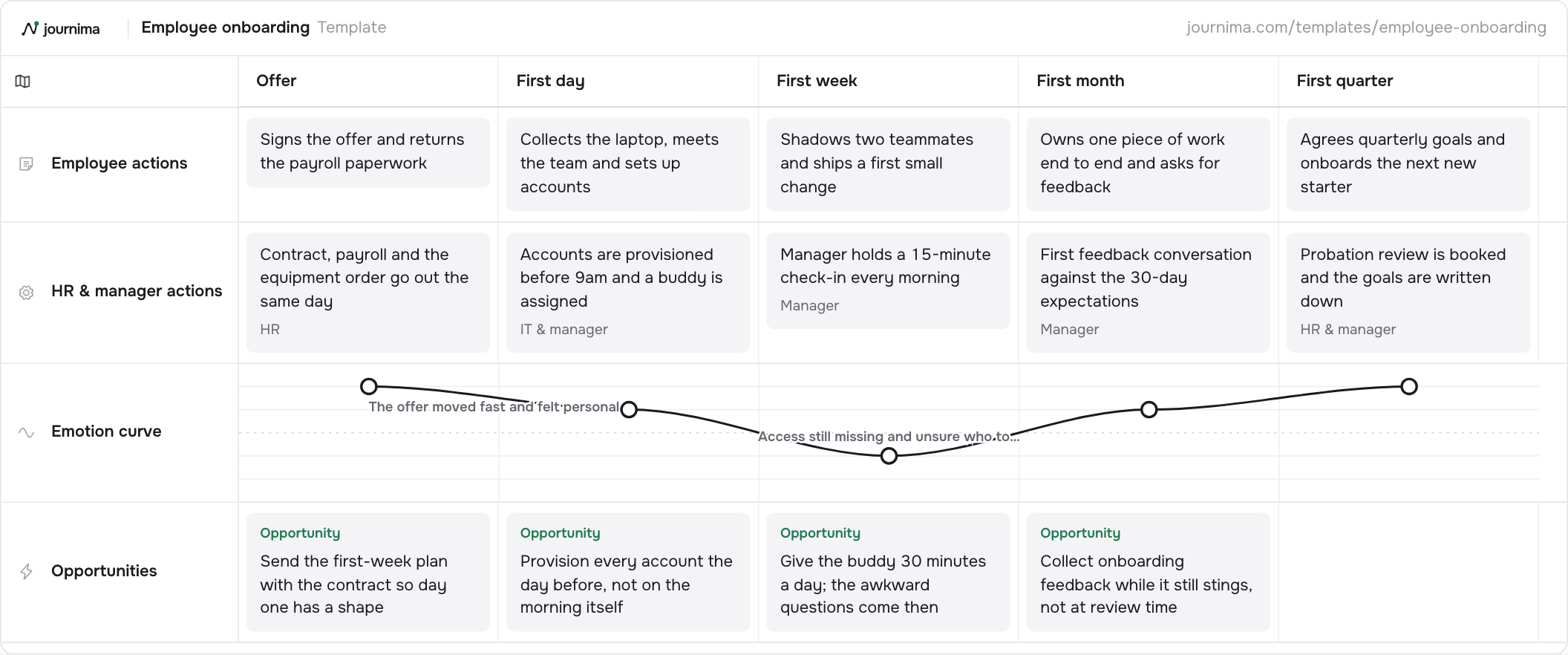
For a journey map that is a fair default. For a blueprint it hides the line of visibility, because inside a company the line moves. Some of these cards happen in front of the new hire. "Manager holds a 15-minute check-in every morning" is a meeting they attend, and so is the "First feedback conversation against the 30-day expectations". Others never reach them at all.
Two cards straddle the line. At Offer, "Contract, payroll and the equipment order go out the same day". The contract and the payroll paperwork reach the new hire; the equipment order never does. On the First day, accounts are provisioned out of sight, while the buddy is a person they meet. Split those two cards before you split the lane.
Then make it a blueprint. Add a Frontstage lane above HR & manager actions and write the seen half into it, with the manager or the buddy in each card's actor field. The lane underneath keeps its owners and only the work the hire never sees. Under that, add a Text lane named Supporting processes for the payroll system, the tool that creates accounts and the system that takes the equipment order.
Employee actions, the new Frontstage lane, HR & manager actions and Supporting processes now make a four-lane blueprint. The curve and the Opportunities lane stay beneath it.
Hotel stay: a service blueprint from the bike repair
No starter covers a hotel, and the bike repair is closer than it looks. Both are one encounter that starts from a listing of what is free, with a counter at each end and the real work done out of sight.
Start from the service blueprint starter and rename its five stages for the stay: Book, Arrive, Stay, Check out and Follow-up. The encounter starts at the booking and stops after the guest has gone home, once the final bill and anything left in the room have reached them.
Then add the lane the starter lacks. A textbook blueprint puts a row of physical evidence above the customer: the things a guest holds or looks at and judges the service by. In Journima that is an Image lane, renamed Physical evidence and moved to the top. Each of its cards takes a picture and a caption.
- Book. The confirmation, and the room photo on the booking page.
- Arrive. The lobby and the key card.
- Stay. The room as the guest found it.
- Check out. The bill.
- Follow-up. The emailed receipt, and the parcel with whatever was left in the room.
At Stay, use a photograph from your research, not the website's. Compare it with the booking page's photo at Book: the gap between the two is a finding before anyone opens the lower lanes.
Frontstage actors are the website at Book and the front desk at Arrive and Check out. Backstage owners are reservations, housekeeping and maintenance. Supporting processes holds the booking engine, the payment terminal and the property management system, where each room's status lives.
One promise above the line carries the whole arrival: the front desk saying the room is ready. A room is ready only when housekeeping has marked it clean, and the desk learns that from the property management system. The promise rests on that one status, the way the bike shop's free slots rest on a calendar sync.
Restaurant meal: a service blueprint from the support case
A restaurant looks like the bike repair: a counter in front and a workshop behind. Adapt the support and complaint starter instead. A meal is judged on a wait, and that starter is the only one with both service lanes and a curve to show it.
Rename the stages Book, Arrive, Order, Eat and Pay. The encounter starts with the booking, or the moment a party walks in, and stops when the bill is paid.
Keep Front line for the floor: the host, the server, whoever brings the bill. Keep Behind the scenes for the kitchen and the bar, with each card's owner naming the station. The line of visibility is the kitchen door. In an open kitchen it moves, and the cooking becomes frontstage.
Keep the Emotion curve for one stretch in particular: the wait between Order and Eat. Score it from what diners say about the wait, then read it against the Front line card above it. A server who tells the table when the food is coming is the restaurant's version of the specialist naming a date.
Then add a Text lane named Supporting processes under Behind the scenes. It holds the booking system at Book, the order tickets or the kitchen display at Order and Eat, and the point-of-sale system at Pay. When a ticket never reaches the kitchen, this row is where to look first, before anyone blames the floor or the cooks.
Last, the Channels lane. Keep it if how the table was booked matters to you: tick Phone, Web or App at Book and leave the other stages empty. If nearly every diner walks in, delete it.
Making your own service blueprint
Choose a starter by the lane your problem lives in, not by your industry. Work that goes missing between teams points to the bike repair, read along Backstage. A wait the customer feels points to the support case and its curve. A service whose customer works in the same building points to onboarding, split at the line.
Delete the example cards before the session and keep the lanes. How to create a service blueprint has the method, from fixing the encounter's two ends to walking the grid for failure points. Service blueprints in Journima covers the lane types, and the templates page has all nine starters.