A patient journey map is a care pathway drawn from the patient's chair rather than the clinician's desk, built from their own account.
This guide is the method for drawing one with a care team. You leave with a span you can defend, the people to invite and a consent routine for the interviews. You also leave with the lanes to add to the starter, and a short list of failures with an owner against each.
Where the pathway starts and ends
A clinical pathway usually starts at referral, because that is the day the service first hears of the patient. Start the map earlier, before the health system knows the patient exists. By the time a referral arrives, the person already has a story about what is wrong and how hard help will be to get. The first stage is where that story begins, and the patient journey starter opens there too: its Symptoms stage comes before any appointment.
End it after discharge, when the person is back to ordinary life. Discharge is where the clinical pathway closes. For the patient it is where the work moves home: the exercises, the medicines, the questions with nobody on hand to answer them. Stop at discharge and the map ends on the service's last task, not the patient's.
Then narrow it. One pathway and one condition per map, drawn as your own service runs it rather than as a guideline describes it. Two conditions on one grid share stages only on paper; the waits and the people differ. If yours moves between organisations, or never ends because the condition is long-term, the patient journey template answers both cases in its questions.
Say the end out loud before the session starts. Clinicians will reasonably want to stop where their own part finishes. Leave the end unsettled and the room settles it for you: the map stops at the last stage anyone in it is responsible for.
Who belongs in the room
Four groups, each holding a part of the pathway the others never see.
- Patients, or people who speak for them. Someone who has walked the pathway recently, or a patient representative who hears from many who have. Nobody else in the room has seen every stage from the inside.
- Carers. The partner, parent or grown-up child who drove to the appointments, made the calls and kept the medicines straight. They see the stretch the patient was too unwell to notice.
- Clinicians. The doctors, nurses and therapists who deliver the care. They know why each step exists, and what it would take to move one.
- Administrative staff. Reception, booking, and the people who handle referrals and letters. They are the easiest group to leave off the invitation.
Administrative staff matter because they hold most of the waits. A referral sitting in a queue, a letter that takes days to arrive, appointment slots released at eight in the morning: each is an administrative step. Each is also a wait the patient feels without seeing its cause. A room of clinicians can explain the treatment. Only the administrative staff can explain the two weeks before it.
Most patients cannot give up a weekday afternoon to a workshop, and some are too unwell to try. Interview them beforehand instead: half an hour each, by phone or after a visit, with the consent the next section describes. Bring what they said into the session without their names, so the room argues with a patient's account rather than with its own guess.
One caution about the seating. A patient still in treatment rarely criticises the clinician treating them, least of all across a table. Invite people whose care has finished, or hear the others in an interview. The rest of the invitation list, and how many to stop at, is in the workshop guide's section on who to invite.
Consent and research material
Patient interviews are the evidence the map stands on. They are also personal accounts of someone's health, and they need handling as such from the first phone call.
Ask for two separate permissions before you start: consent to record the conversation, and consent to quote from it. Say who will read the material, that quotes will appear on a map shared inside the organisation, and that no name will travel with them. Whoever handles data protection in your organisation decides the legal basis, so ask them before the first interview, not after the tenth. Keep the signed forms in your own research files, never in the mapping tool.
Then pseudonymise, before anything is uploaded. Give each person a label such as P3. Take out every detail that identifies someone alone or in combination: a date of birth, a hospital number, an address, a rare condition in a small town. Only the pseudonymised version goes into the research hub.
Names, identifiers and clinical records stay out of the workspace entirely. That includes a referral letter or a test result with the name blacked out. The map needs what the person went through, not what was written about them. The data processing agreement says it plainly: Journima is not designed for health records, so do not upload them. What happens to research material once it is in the workspace is on the security and privacy page.
The lanes that earn their place
Start from the starter's four lanes: Patient actions, Touchpoints, an Emotion curve, and Pains & opportunities, over six stages from Symptoms to Aftercare. All four describe the patient's side of the desk. That is the right place to begin, and not enough to finish.
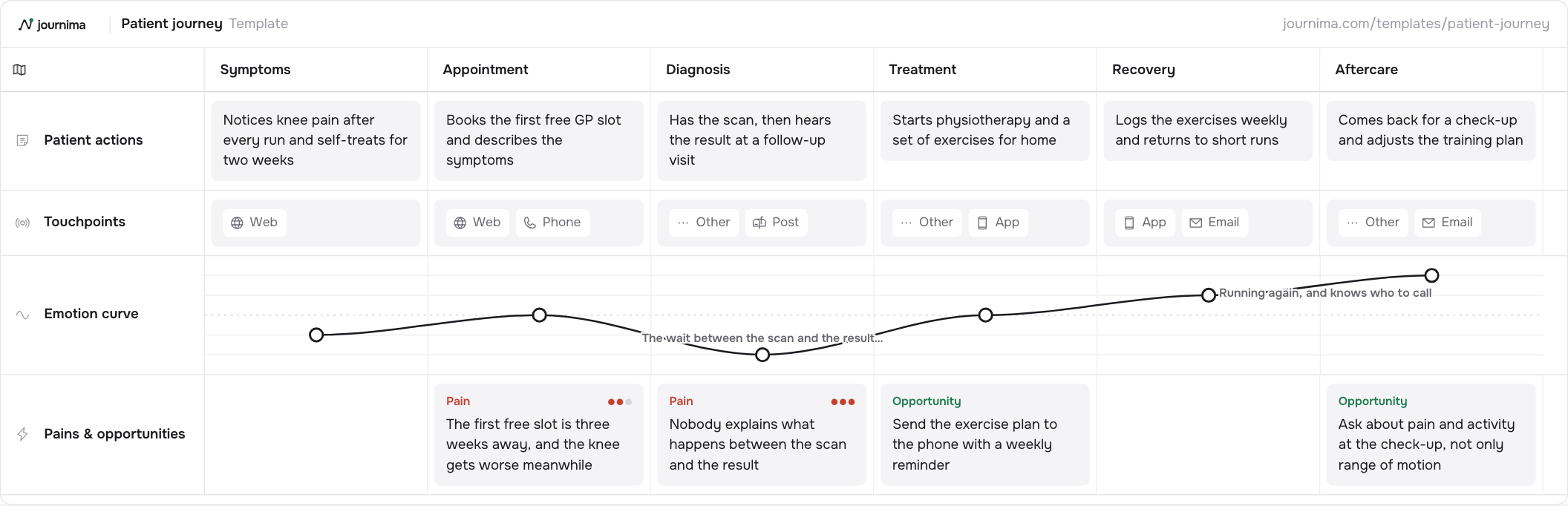
For a reading of the starter itself, the curve and the touchpoints included, see the patient journey map example. What follows is what to add.
- A Backstage lane for the clinical and administrative steps the patient never sees: the referral being triaged, the scan being reported, the letter being typed. Each backstage card has an owner field. Fill it with a team or a role rather than a person, so the map still holds when people move on.
- A Frontstage lane for what the patient meets: the receptionist, the phone line, the specialist, the text reminder. Each card's actor field says who or what the patient deals with at that step.
- A Divider lane between the two. It holds no cards; it is a labelled line across the map. Label it as the line of visibility and the room can see where the patient's view stops. The blueprint guide explains that line and its partner.
- A carer as a second persona. The starter's curve is the map's overall line, tied to nobody. Attach a patient persona and a carer persona, and each scores the stages on a line of their own. Where the carer's line falls and the patient's does not, the service has handed a job to someone it never counted.
Turning the map into fixes
A finished map is a list of problems that have not yet been given to anyone. Four moves change that, a care version of the blueprint guide's closing steps.
- Number the failure points while the room is still there. Walk the map one stage at a time and mark each place where the patient had to chase the service, rather than the other way round. A number on the map outlasts any description of it.
- Give each one an owner from the backstage lane. The failure shows up in the patient's row, but the owner field on the backstage card beneath it says which team can change it. If there is no backstage card beneath it, the work is being done on goodwill, and goodwill does not survive a staff change.
- Move the stubborn ones into the portfolio. Many failure points can be fixed within weeks by the team that owns them: a reworded letter, a phone line that opens an hour earlier. The ones still open a month later become items in the portfolio, where each takes a key, a status and a score.
- Read it back to patients before acting. Take the numbered map to two or three patients or their representatives and walk them through it. They will tell you which failures mattered and which only annoyed the staff. A fix chosen without that reading answers the room's question, not the patient's.
If the team needs one shared place for the map, its evidence and its owners, patient journey software for healthcare teams covers what Journima offers. When the clinic's half deserves a grid of its own, the guide to creating a service blueprint picks up where the backstage lane stops.