Search for customer journey stages and the answer is usually the same five words: awareness, consideration, purchase, retention, advocacy. They are not wrong. They are somebody else's stages, lifted from a funnel, and a map built on them describes your marketing rather than your customer.
The top row is the one decision on a map you cannot change later without redrawing everything underneath it. So it is worth an hour. What a stage is, how many to draw, what to call them, and what the three starters put across the top.
What a stage actually is
A stage is a change in what the customer is trying to do.
That definition rules out a great deal of what gets written across the top of maps. A department is not a stage, because customers do not travel between your departments. A funnel step is not a stage either; it is something you count. A calendar month is not a stage unless something changed for the person inside it.
The test is one question at every boundary. What did this person stop trying to do at this line, and what did they start trying to do instead? If the answer is the same on both sides, the line is decoration.
Two cases, side by side. Between Consideration and Purchase the goal really does change: choosing stops and paying starts. Between two internal columns called Enquiry and Opportunity, nothing changed for the customer at all. What moved was a field in your CRM.
The hub's anatomy section puts stages, lanes and cards together in one picture. This page is about the top row only.
How many stages a map needs
There is a usual answer and there is a test. The usual answer is five to seven, which the hub gives along with the width at which a map has quietly become two. The test is more useful, because it runs on your journey rather than an average one.
- Too few, and one card has to carry a sequence. Read the actions lane aloud. When a single card needs the word then in the middle of it, two things happened in that column, and one of them wants its own.
- Too many, and a boundary has no answer. Walk the top row asking the goal question at every line. The first line you cannot answer is the one to delete, and the columns either side of it merge without losing a card.
Two hard limits come from the room rather than from theory. Below four columns, read the map aloud and count the objections; if there are none, a paragraph would have done the same job. Past eight or nine, ask somebody to read the top row back from memory. The columns they drop tend to be the ones the room has already stopped arguing about.
Count the cells before you commit to a width. The basic starter fills twelve of them; the detailed one fills twenty-eight. Every column you add is multiplied by every lane underneath, which is why width costs more than it looks.
Naming stages in the customer's words
This advice is given constantly and it is still hard to take, because the customer's words sound unpolished in a steering group. Take it anyway. Four moves make it practical.
- Take the names from transcripts, not from the whiteboard. Open the last round of interviews and look for the words people used about time: waiting, chasing, trying again, giving up. If nobody has said a word out loud, it does not belong across the top.
- Test a name by finishing a sentence. Put I am in front of it. I am comparing works. I am in acquisition does not, and whoever wrote it already knows.
- Keep the awkward ones. When a stage is honestly called chasing you, the name is already a finding. Rename it to Follow-up and you have swapped that finding for a label.
- Let the internal name stay internal. Finance and the pipeline need their own vocabulary. Put it in a tag or a lane, never across the top, so the map keeps one voice.
One rule of thumb to finish: a stage name that needs a comma in it is two stages. Running that argument with eight people in a room is twenty minutes of the half-day workshop agenda.
Three real stage sets, compared
Three starters, three shapes. The names below are the ones in the files, in the order the files put them.
| Starter | The stages, in order | What the shape says |
|---|---|---|
| Basic customer journey | Awareness, Consideration, Purchase, Retention | The funnel, with the customer's own ending attached |
| Detailed customer journey | Awareness, Research, Comparison, Purchase, Onboarding, Retention | The same journey, opened where the buyer does the work |
| B2B buyer journey | Problem recognition, Solution exploration, Requirements, Vendor selection, Negotiation, Rollout | A committee's own process, with no Purchase column in it |
Four stages, because agreement is the job. The basic starter never splits Consideration and it stops at Retention. The first three columns are the funnel as written by whoever sells the thing. The fourth is the correction, and it is the important one: the journey does not end when the money arrives.
Six stages, because the buyer works where you cannot see. The detailed starter keeps the first and last names and opens the middle. Research and Comparison were both hiding inside Consideration, and they are different jobs, because reading is not comparing. Onboarding earns its column by sitting after Purchase, which is where a funnel stops looking. The note on its curve at Comparison says the problem plainly: "Every vendor counts seats differently".
Six stages, and no column named Purchase. The B2B set runs from Problem recognition to Rollout. Three of the six happen before a vendor is in the conversation at all, and the sixth is about getting the thing used. Read it as a warning about stage sets generally. These columns belong to the buyer's process, and a set that mirrors your pipeline ends up with a column for each of your steps and none of theirs.
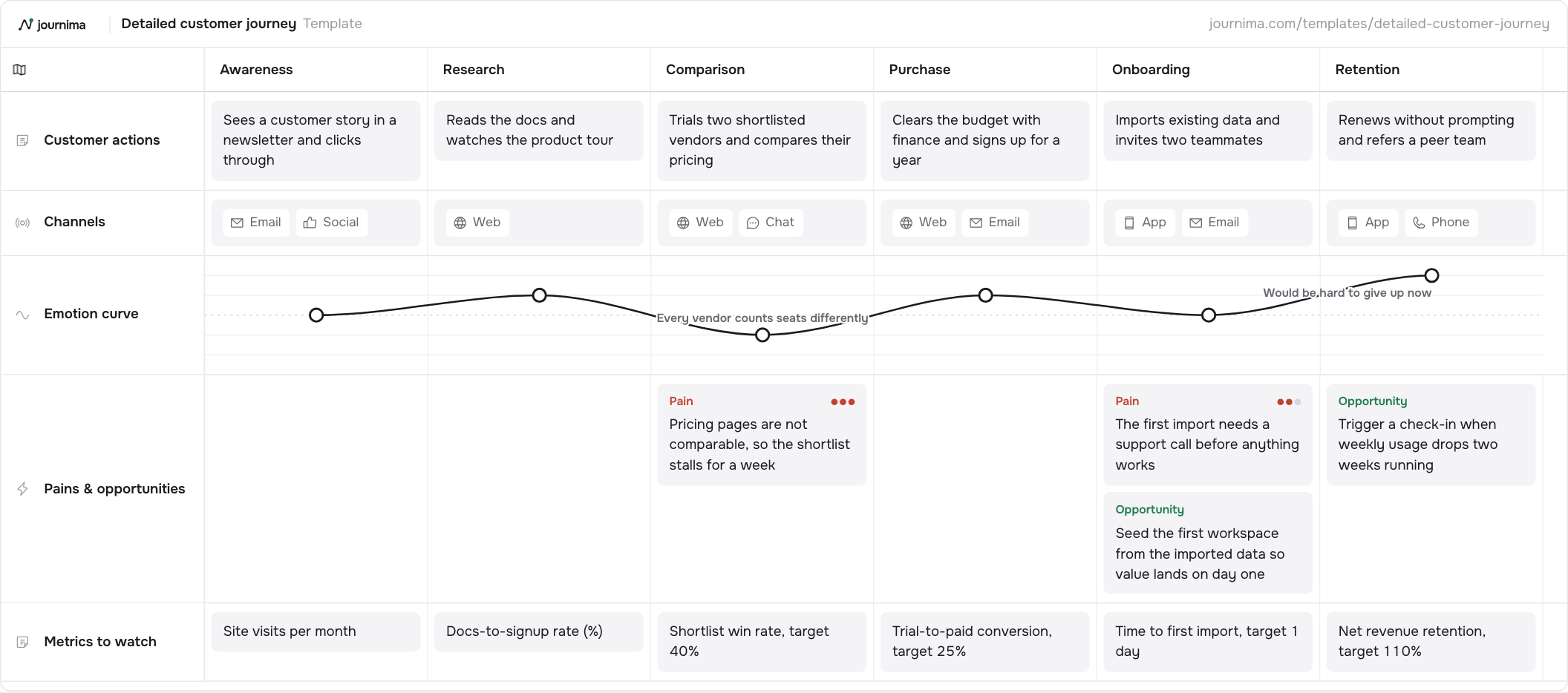
Lay the three side by side and the difference is not more detail. It is a different traveller each time: one person, one person with a budget cycle, and a group who have to agree. Six of these read industry by industry are in the guide to journey map examples.
Stages, lanes and touchpoints
These three get confused because all of them are described as parts of a grid. They answer different questions. A stage is when. A lane is what kind of thing you are recording. A touchpoint is neither: it is a card, sitting in a lane, under a stage.
Knowing the difference prevents one specific map. If your top row reads Website, Email, Call centre and Shop, you have drawn an inventory of channels and time has left the page. The test is order. Shuffle the columns, and if the story still reads, they were never stages.
The three starters give the same row three different names, which is worth noticing. The basic map calls it Touchpoints and the detailed one calls it Channels. The B2B one calls it "Content & channels", because what a committee reaches for is mostly reading. One question, three names, because the answer is not the same shape.
Stages that loop or branch
Real journeys loop. A shopper goes back to comparing after a bad delivery. A case goes round triage twice. A renewal is the same journey again in a different mood.
A grid is linear, and drawing arrows back across it does not rescue that. A map with arrows pointing left reads as a flow chart and stops being scannable. Three honest options instead.
- Cut the loop where the goal changes. A second pass is rarely the same journey with a lower score. The person now wants something different, which by the definition above makes it a different journey, and it deserves its own map.
- Record the return as a card, not as a column. Put it in the actions lane at the point it happens, naming the stage the customer goes back to. The map stays readable and the loop is still on the page.
- Use a second curve rather than a second row of columns. When the only difference between the first pass and the second is how it feels, attach two personas and let each carry its own line. The hub's section on personas covers how many a map can hold.
Branches take the same treatment. A journey that forks at a decision is usually two travellers, and two travellers means two curves or two maps. Drawing both forks as columns doubles the width and halves the readers.
When one journey is two maps
Four signals that the top row is trying to hold two journeys.
- Two travellers who never meet. The person who buys and the person who uses live different weeks. One map with both in it is an average neither would recognise.
- Two time spans. A twenty-minute checkout and a three-year relationship cannot share a top row. Whichever one you draw at the wrong scale vanishes.
- A column with columns inside it. When one stage needs four cards in every lane and still feels compressed, it is a journey of its own. A linked-map lane in Journima nests that detail under the stage, so the wide map stays wide and the detail sits one click below.
- A stage whose cards keep naming other teams. That is not a stage problem. Take that one column to how to create a service blueprint instead.
And when the top row is not a sequence at all, the artefact itself may be wrong. Journey map, experience map, user flow or empathy map compares the alternatives.
Get the top row right and the rest of the map is filling in. Get it wrong and every lane underneath inherits the error, which is why the columns are worth arguing about before anybody writes a card. The step-by-step guide covers the hours after that.