Hears about the product from a friend or an ad
Basic customer journey template
A minimal end-to-end journey: what the customer does, where it happens, and how it feels.
Basic customer journeyTemplate
01Awareness
02Consideration
03Purchase
04Retention
Customer actions
Compares plans and reads reviews
Creates an account and completes the first order
Returns for a second purchase and recommends it
Touchpoints
- Social
- Ads
- Web
- Web
- App
Emotion curve
What is in the basic customer journey map template
4 stages
- Awareness
- Consideration
- Purchase
- Retention
3 lanes
- Customer actions
- Text
- Touchpoints
- Channels
- Emotion curve
- Emotion curve
When four stages are enough
Use it for a first map, a workshop warm-up or a journey nobody has written down yet. Four stages and three lanes are enough to agree on what the customer does, where it happens and how it feels. It is the template teams outgrow, which is the point.
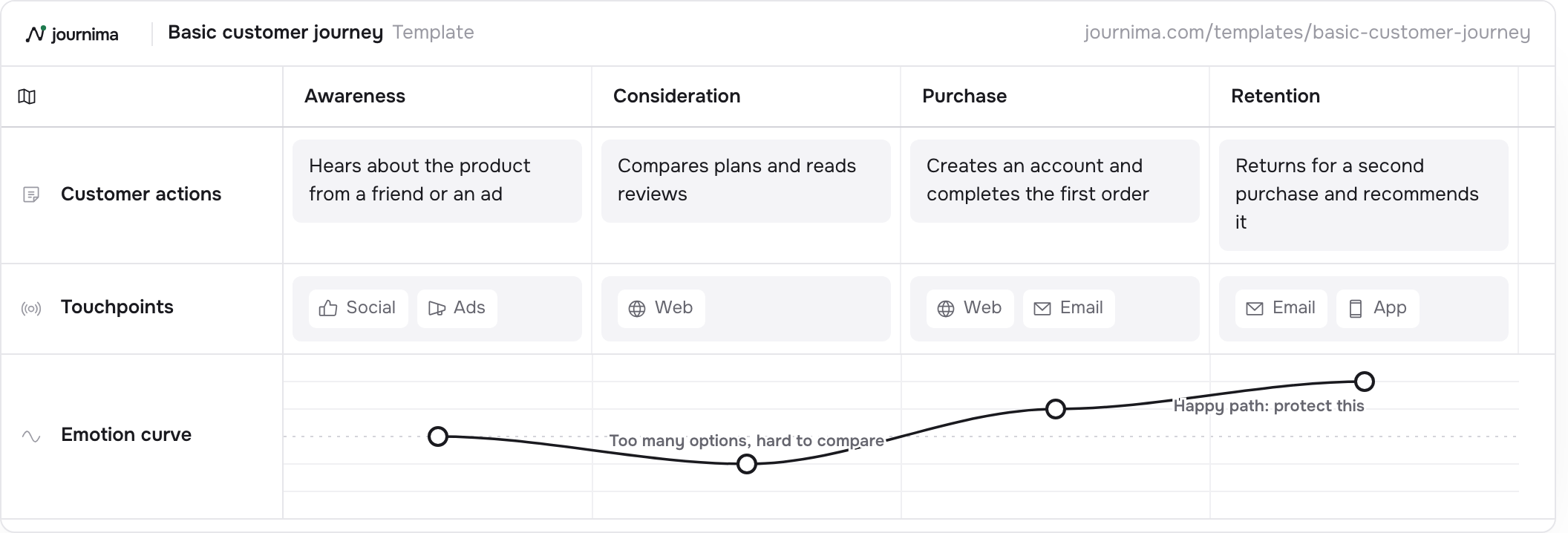
The example takes one customer through four stages: Awareness, Consideration, Purchase and Retention. Under them sit three lanes. What the customer does, the touchpoints they reach, and a curve that dips at Consideration because there are too many options to compare.
Four stages and three lanes fit on one screen, which is why this map survives a workshop. Nobody spends the first hour arguing about structure. Most teams outgrow it within a project or two, and that is a sign it did its job.
How to fill it in
- Name the four stages in your customers' words. Awareness, Consideration, Purchase and Retention are funnel words. If your customers would say looking, choosing, buying and coming back, use those instead.
- Fill Customer actions from their side. One action per stage, written the way the customer would describe it. The example starts with hearing about the product from a friend or an ad, not with a campaign impression.
- Add the Touchpoints underneath. Mark where each action happens: social, an ad, the web, email, the app. The example never uses more than two per stage, because a stage with five touchpoints is usually two stages.
- Draw the emotion curve last. Score every stage from minus two to plus two, then write a note only where the score needs explaining. The example annotates two points: the dip at Consideration and the high at Retention.
- Leave with one stage to investigate. This template has no pain lane, so the dip is the finding. Agree which stage somebody will bring evidence about before the room empties.
Download the template
Download for ExcelA spreadsheet, one column per stage.
Download as PNGThe whole grid as one picture.
The Excel file opens in Excel, Numbers and Google Sheets. Fill it in, then import it into Journima when you have an account.
How to adapt it
- Rename the stages to your own funnel words before the workshop.
- Add a pains and opportunities lane once the group starts arguing about what is broken.
- Attach a persona and let the emotion curve split by who is travelling.
Questions about the basic customer journey map template
What is a customer journey map?
It lays out one person's path to a goal, then stacks what you know under each step: where it happened, what they touched, how it felt. The value is that a mixed group can point at the same picture and argue about the right thing. More in the guide.
How many stages should a first map have?
Four, as here, is a floor rather than a target. The useful test is not the count: if two stages always take the same touchpoints and the same feeling, they are one stage wearing two names. Split where the customer's goal changes.
Do we need a persona before we start?
Not for the first pass. Map the customer your team argues about most, then give them a name and a goal. Personas start to matter when two groups clearly travel differently, because then a single curve is no longer honest.
Where do the emotion scores come from?
Interviews, support tickets and the last survey, before anyone's memory. If memory is all you have, score it anyway and mark the map as a hypothesis until somebody checks it. How to draw a curve people believe
Keep reading
Other templates
Detailed customer journey
A fuller journey with channels, an emotion curve, pains and opportunities, and the metrics to watch.
6 stages · 5 lanes TextChannelsEmotion curvePains and opportunitiesService blueprint
Frontstage and backstage view of one service encounter, from first contact to follow-up.
5 stages · 4 lanes TextFrontstageBackstageDay in the life
Shadow one person through a typical day to find the moments that matter.
5 stages · 4 lanes TextChannelsEmotion curvePains and opportunitiesEmployee onboarding
The new hire's first quarter: actions on both sides and how the experience feels.
5 stages · 4 lanes TextBackstageEmotion curvePains and opportunitiesB2B buyer journey
A buying committee's path from problem to rollout, with content touchpoints and deal metrics.
6 stages · 4 lanes TextChannelsPains and opportunitiesE-commerce purchase journey
From discovery to post-purchase: where shoppers drop off and what to measure.
6 stages · 5 lanes TextChannelsEmotion curvePains and opportunitiesSupport & complaint journey
A support case end to end: customer, front line, and what happens behind the desk.
5 stages · 5 lanes TextChannelsFrontstageBackstageEmotion curvePatient journey
A care journey from first symptoms to aftercare, tracking experience along the way.
6 stages · 4 lanes TextChannelsEmotion curvePains and opportunitiesSee your journeys take shape.
Start your free 14-day trial. No card needed.