Ops lead escalates a manual process the team can no longer absorb
B2B buyer journey template
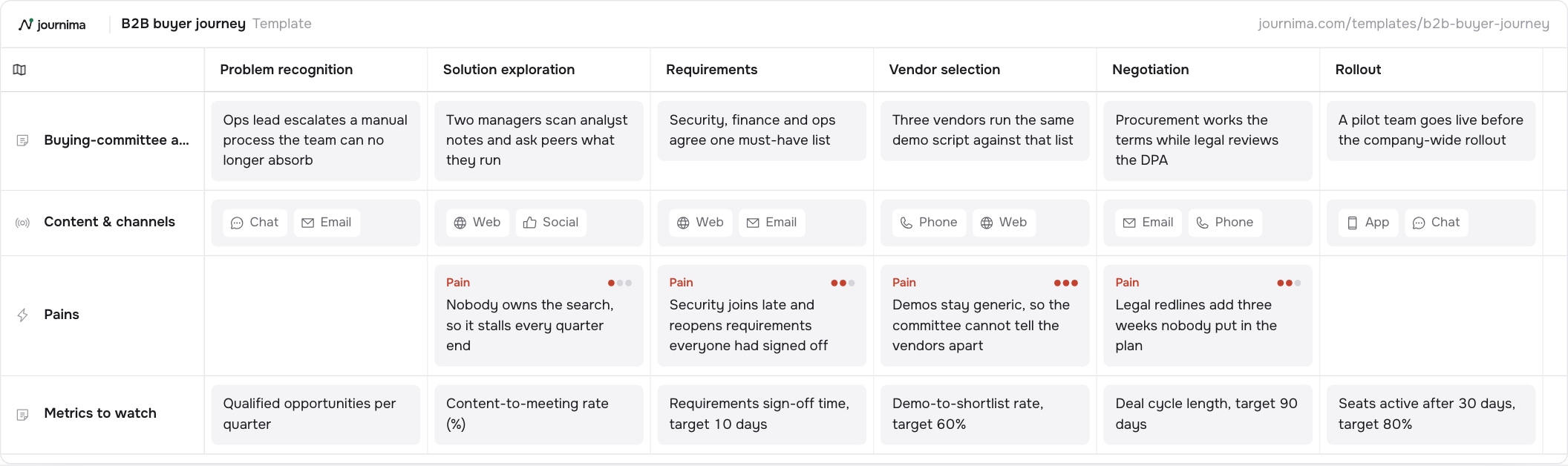
A buying committee's path from problem to rollout, with content touchpoints and deal metrics.
B2B buyer journeyTemplate
01Problem recognition
02Solution exploration
03Requirements
04Vendor selection
05Negotiation
06Rollout
Buying-committee actions
Two managers scan analyst notes and ask peers what they run
Security, finance and ops agree one must-have list
Three vendors run the same demo script against that list
Procurement works the terms while legal reviews the DPA
A pilot team goes live before the company-wide rollout
Content & channels
- Chat
- Web
- Social
- Web
- Phone
- Web
- Phone
- App
- Chat
Pains
Pain
Nobody owns the search, so it stalls every quarter end
Pain
Security joins late and reopens requirements everyone had signed off
Pain
Demos stay generic, so the committee cannot tell the vendors apart
Pain
Legal redlines add three weeks nobody put in the plan
Metrics to watch
Qualified opportunities per quarter
Content-to-meeting rate (%)
Requirements sign-off time, target 10 days
Demo-to-shortlist rate, target 60%
Deal cycle length, target 90 days
Seats active after 30 days, target 80%
What is in the B2B buyer journey map template
6 stages
- Problem recognition
- Solution exploration
- Requirements
- Vendor selection
- Negotiation
- Rollout
4 lanes
- Buying-committee actions
- Text
- Content & channels
- Channels
- Pains
- Pains and opportunities
- Metrics to watch
- Text
When to map a buying committee
Use it when several people buy and none of them is the user. Six stages follow a buying committee from noticing a problem to rolling out a vendor. The content lane shows what they read at each step, the pains show where deals stall, and the metrics lane keeps the pipeline numbers next to the story.
The example runs six stages, from Problem recognition to Rollout. There is no emotion lane, and that is deliberate. A committee does not feel one thing, so this map tracks what the group does, what it reads, where it stalls, and the deal numbers that follow.
Reach for it when deals keep stopping in the same place and nobody can name who stopped them. The Pains lane holds four cards, and the first one says it plainly: nobody owns the search, so it stalls every quarter end. The other three sit at Requirements, Vendor selection and Negotiation.
How to fill it in
- List the committee before the stages. Write down every role that can say no: the ops lead, security, finance, procurement, legal. In the example they arrive in three stages, and two of those cards carry more than one role.
- Write Buying-committee actions as group decisions. Not what your champion does, but what the group agreed. The example opens with an ops lead escalating a manual process the team can no longer absorb.
- Fill Content & channels with what they actually read. Analyst notes, a peer conversation, your documentation, a demo call. The example starts in chat and email, moves to the web, and ends in the app once a pilot team is live.
- Mark the Pains where the deal stops. The example scores the generic demo highest, because the committee cannot tell the vendors apart. The late security review and the legal redlines sit a step below it, and the unowned search lowest of the four. Severity keeps the argument off whoever complained loudest.
- Put a deal number under each stage. The example pairs Requirements with a sign-off time and Vendor selection with a demo-to-shortlist rate. Use numbers your pipeline already reports, so nobody has to build a query to keep the map honest.
- Carry the map past the signature. The last stage is Rollout, measured by the seats active after thirty days. A deal that closes and never gets used looks identical to a good one until the renewal.
Download the template
Download for ExcelA spreadsheet, one column per stage.
Download as PNGThe whole grid as one picture.
The Excel file opens in Excel, Numbers and Google Sheets. Fill it in, then import it into Journima when you have an account.
How to adapt it
- Add a persona per committee role: champion, economic buyer, security reviewer.
- Replace the metrics with your pipeline conversion rates.
- Map the renewal as a second map and link it.
Questions about the B2B buyer journey map template
What is a B2B buyer journey map?
It is a journey map whose traveller is a group. The stages follow the buying process from problem recognition to rollout, and the actions lane records what the committee agreed rather than what a single contact clicked.
How is it different from a sales funnel?
A funnel counts your side of the deal: leads, meetings, closed business. A buyer journey describes theirs, including the weeks when nothing at all reaches your CRM. Two of the four pains in this template sit in exactly those weeks, before a vendor is involved.
Should each committee role get its own persona?
Once the stages hold, yes. A champion, a budget holder and a security reviewer want different things from the same demo. Personas carry a colour through the map, so a card shows at a glance whose concern it is.
How do you find out what the committee did without you?
Win-loss interviews, then the deal desk's own notes. Ask the buyer who else had to approve it and at which point. The committee's internal steps leave no trace in your pipeline, and they are where this map earns its place.
Keep reading
Other templates
Basic customer journey
A minimal end-to-end journey: what the customer does, where it happens, and how it feels.
4 stages · 3 lanes TextChannelsEmotion curveDetailed customer journey
A fuller journey with channels, an emotion curve, pains and opportunities, and the metrics to watch.
6 stages · 5 lanes TextChannelsEmotion curvePains and opportunitiesService blueprint
Frontstage and backstage view of one service encounter, from first contact to follow-up.
5 stages · 4 lanes TextFrontstageBackstageDay in the life
Shadow one person through a typical day to find the moments that matter.
5 stages · 4 lanes TextChannelsEmotion curvePains and opportunitiesEmployee onboarding
The new hire's first quarter: actions on both sides and how the experience feels.
5 stages · 4 lanes TextBackstageEmotion curvePains and opportunitiesE-commerce purchase journey
From discovery to post-purchase: where shoppers drop off and what to measure.
6 stages · 5 lanes TextChannelsEmotion curvePains and opportunitiesSupport & complaint journey
A support case end to end: customer, front line, and what happens behind the desk.
5 stages · 5 lanes TextChannelsFrontstageBackstageEmotion curvePatient journey
A care journey from first symptoms to aftercare, tracking experience along the way.
6 stages · 4 lanes TextChannelsEmotion curvePains and opportunitiesSee your journeys take shape.
Start your free 14-day trial. No card needed.