Checks the day's route on the dispatch app before leaving home
Day in the life template
Shadow one person through a typical day to find the moments that matter.
Day in the lifeTemplate
01Early morning
02Morning
03Midday
04Afternoon
05Evening
Activities
Clears two callouts and orders a part for the second one
Eats in the van while writing up the morning jobs
Waits for the part, then finishes the repair on site
Files the timesheet and job photos from the sofa
Touchpoints
- App
- Phone
- App
- Chat
- App
- Phone
- App
Emotion curve
Pain points
Pain
Route changes land after the van is already loaded
Pain
A missing part turns one visit into two
Opportunity
Let technicians reserve van stock the night before from the next day's jobs
Pain
Write-ups spill into the evening because the form is slow on mobile
What is in the day in the life map template
5 stages
- Early morning
- Morning
- Midday
- Afternoon
- Evening
4 lanes
- Activities
- Text
- Touchpoints
- Channels
- Emotion curve
- Emotion curve
- Pain points
- Pains and opportunities
When to map a day instead of a journey
Use it when the product is a small part of someone's day and you need to know which part. Five slices of a day, the person's activities, the touchpoints they reach for and how the day feels. It finds the moments that matter before you map a journey around them.
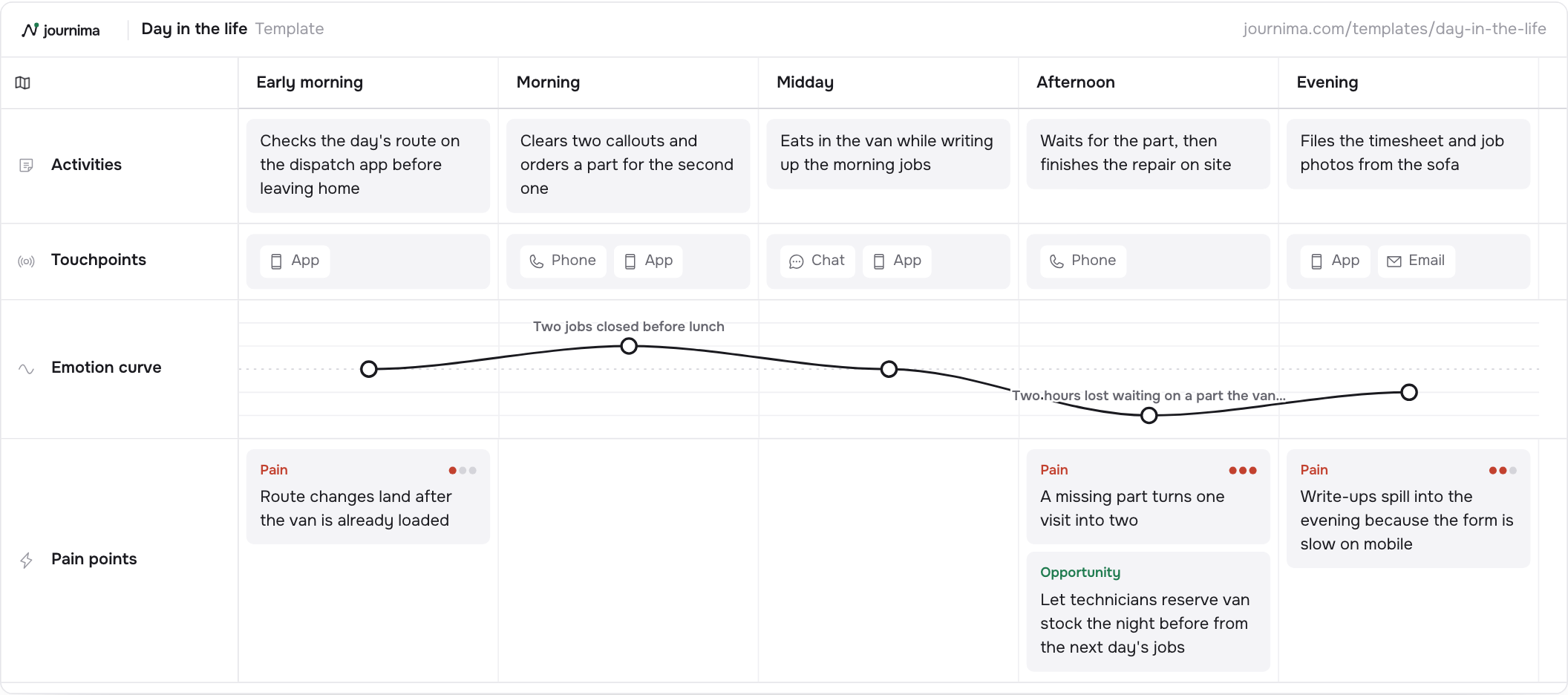
The example follows one field technician from Early morning to Evening. The day opens with the route on the dispatch app and closes two callouts before lunch. The Afternoon loses two hours waiting on a part the van should carry, and the write-up happens on the sofa.
Draw it when you do not yet know which journey to map. A day in the life shows where your product sits in somebody's working day and how much of that day it costs them. It belongs before you commit to a journey, not after.
How to fill it in
- Shadow one person, not a role. One technician, one nurse, one buyer. A composite day is an average of days nobody actually had, and you cannot design against an average.
- Slice the day the way they live it. The example uses five slices: Early morning, Morning, Midday, Afternoon and Evening. Cut finer where your product appears and coarser where it does not.
- Write the Activities lane while you watch. One activity per slice, in the order it happened, before anybody interprets it. Verbs and objects: checks the route, clears a callout, orders a part.
- Mark the Touchpoints they reached for. The dispatch app, the phone, a chat, an email at the end of the day. Tools people use without being told to are the ones worth designing for.
- Score the curve from the day's own moments. The example rises after two jobs close before lunch and bottoms out at minus two in the Afternoon. Score what the person said at the time, not their summary of the day afterwards.
- Collect the Pain points and give them a severity. Three sit in the example: a late route change, a missing part, a write-up form that is slow on mobile. Only one carries an opportunity, because an opportunity nobody can resource is a wish.
Download the template
Download for ExcelA spreadsheet, one column per stage.
Download as PNGThe whole grid as one picture.
The Excel file opens in Excel, Numbers and Google Sheets. Fill it in, then import it into Journima when you have an account.
How to adapt it
- Shadow one real person and fill it in the same afternoon.
- Split the day finer where your product shows up.
- Turn the pain points into interview questions for the next round.
Questions about the day in the life map template
What does a day in the life map show?
One person's whole day in order: what they did, what they used, how it felt and what got in the way. Your product appears only where they reached for it, which is the reason to draw the whole day rather than your part of it.
When would you draw one instead of a customer journey map?
When the goal is not your product. A journey map assumes the person is trying to do business with you. A day map assumes they are trying to get through a shift, and that your product is a few minutes of it.
How do you gather the material?
Shadow one person for a full shift and write down the times. Interviews recall the exceptional and forget the routine, and the routine is where the hours go. If shadowing is impossible, ask someone to narrate yesterday hour by hour.
Should it be a typical day or a bad one?
A typical day first. Bad days are easy to remember and easy to over-weight. Once the typical day is on the canvas, map a bad one beside it and compare the two curves.
Keep reading
Other templates
Basic customer journey
A minimal end-to-end journey: what the customer does, where it happens, and how it feels.
4 stages · 3 lanes TextChannelsEmotion curveDetailed customer journey
A fuller journey with channels, an emotion curve, pains and opportunities, and the metrics to watch.
6 stages · 5 lanes TextChannelsEmotion curvePains and opportunitiesService blueprint
Frontstage and backstage view of one service encounter, from first contact to follow-up.
5 stages · 4 lanes TextFrontstageBackstageEmployee onboarding
The new hire's first quarter: actions on both sides and how the experience feels.
5 stages · 4 lanes TextBackstageEmotion curvePains and opportunitiesB2B buyer journey
A buying committee's path from problem to rollout, with content touchpoints and deal metrics.
6 stages · 4 lanes TextChannelsPains and opportunitiesE-commerce purchase journey
From discovery to post-purchase: where shoppers drop off and what to measure.
6 stages · 5 lanes TextChannelsEmotion curvePains and opportunitiesSupport & complaint journey
A support case end to end: customer, front line, and what happens behind the desk.
5 stages · 5 lanes TextChannelsFrontstageBackstageEmotion curvePatient journey
A care journey from first symptoms to aftercare, tracking experience along the way.
6 stages · 4 lanes TextChannelsEmotion curvePains and opportunitiesSee your journeys take shape.
Start your free 14-day trial. No card needed.