Taps a paid social post showing a jacket in the right size
E-commerce purchase journey template
From discovery to post-purchase: where shoppers drop off and what to measure.
E-commerce purchase journeyTemplate
01Discover
02Browse
03Cart
04Checkout
05Delivery
06Post-purchase
Customer actions
Filters by size and price, then reads the newest reviews
Adds two sizes to the cart to decide at home
Pays with a saved wallet and picks a locker for delivery
Tracks the parcel and collects it on the way home
Returns the smaller size and keeps the other
Channels
- Social
- Ads
- Web
- App
- App
- App
- In store
- Chat
Emotion curve
Pains & opportunities
Pain
Delivery cost and date are still hidden, so the cart is left open
Pain
Guest checkout sits below account creation and gets missed
Opportunity
Let shoppers redirect a parcel to a locker after dispatch
Opportunity
Refund on carrier scan-in instead of on warehouse receipt
Metrics to watch
Cost per session (EUR)
Search-to-product rate (%)
Cart abandonment rate, target 60%
Checkout completion rate, target 75%
On-time delivery, target 95%
Return rate, target 12%
What is in the e-commerce purchase journey template
6 stages
- Discover
- Browse
- Cart
- Checkout
- Delivery
- Post-purchase
5 lanes
- Customer actions
- Text
- Channels
- Channels
- Emotion curve
- Emotion curve
- Pains & opportunities
- Pains and opportunities
- Metrics to watch
- Text
When to map a shop as a journey
Use it for a shop, from discovery to the second order. Six stages, channels including the store, an emotion curve, and the pains where carts die and returns start. The metrics lane is built for conversion, delivery and return rates.
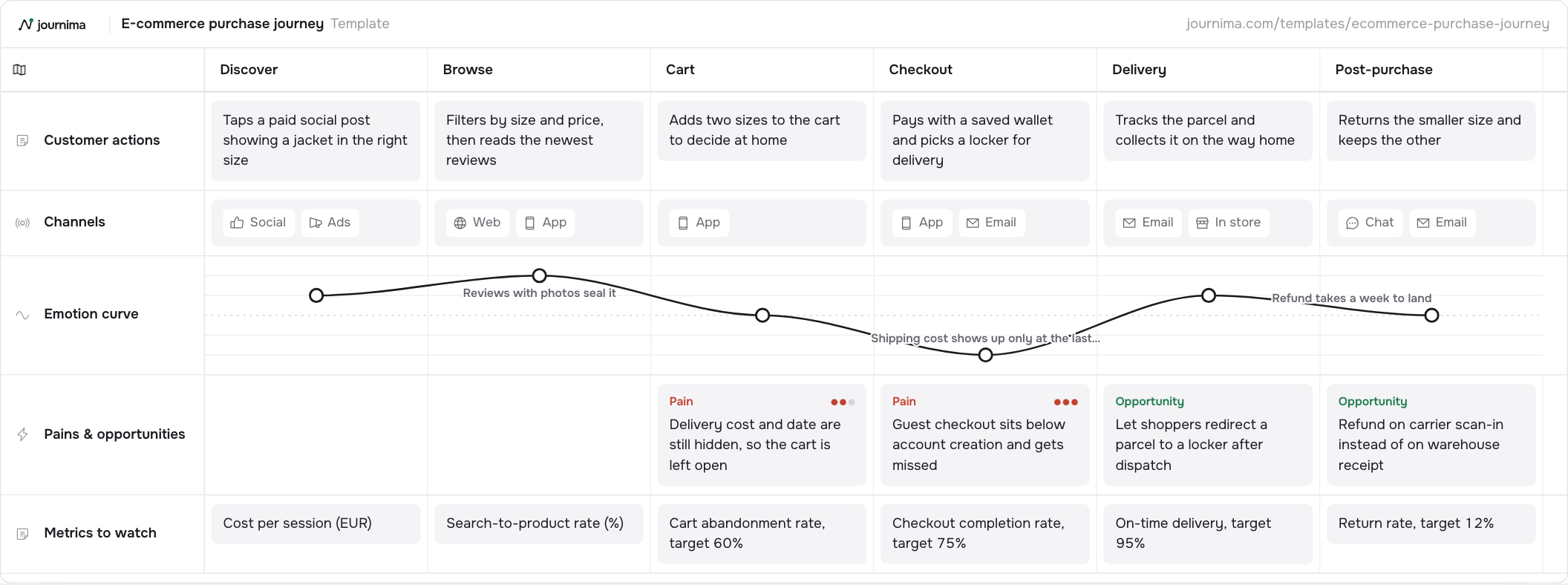
The example follows one shopper buying a jacket, from a paid social post to a return. Six stages: Discover, Browse, Cart, Checkout, Delivery and Post-purchase. The curve peaks at Browse, where reviews with photos seal it, then falls to minus two at Checkout, where the shipping cost appears at the last step.
Analytics will tell you the cart sat open. It will not tell you that the delivery cost and date were still hidden while the shopper decided at home. It will not tell you that guest checkout sits below account creation and gets missed. Those two cards are the point of the map.
How to fill it in
- Start at Discover, not at the product page. The example opens on a paid social post showing a jacket in the right size. A map that starts at the homepage skips the half of the journey you pay for.
- Write Customer actions as one purchase. One shopper, one item, one basket. The example adds two sizes to the cart to decide at home, which is the behaviour that produces the return at the end.
- Mark the Channels, including the ones off the screen. This journey runs through social, an ad, the web, the app, email, chat and a collection in person. A channel lane listing only the website cannot explain the drop-off.
- Score the curve at the moment of paying. The example drops two points between Cart and Checkout. Ask a shopper what they felt while paying, because a survey sent afterwards records relief rather than the wobble.
- Pair every pain with the number it moves. The example puts the open cart next to a cart abandonment rate, and the missed guest checkout next to a checkout completion rate. Both are numbers a shop already reads every morning.
- Finish after the parcel arrives. Two opportunities sit in the last stages: redirect a parcel to a locker after dispatch, and refund on carrier scan-in instead of on warehouse receipt. Both shorten a wait the shopper is already counting.
Download the template
Download for ExcelA spreadsheet, one column per stage.
Download as PNGThe whole grid as one picture.
The Excel file opens in Excel, Numbers and Google Sheets. Fill it in, then import it into Journima when you have an account.
How to adapt it
- Split Delivery into carrier steps if that is where complaints cluster.
- Turn the metrics into metric cards bound to your analytics export.
- Add a persona for the returning customer and compare curves.
Questions about the e-commerce purchase journey template
Should the map cover returns?
Yes. The example ends with one size returned and one kept, and the refund taking a week to land. A map that stops at Delivery records the sale and misses the reason the second order never happens.
How do you map mobile and desktop shoppers?
As two personas on one map, not as two maps. Each attached persona gets its own emotion curve, so you can see where the paths separate. The stages stay the same; the channels and the checkout wobble do not.
Which numbers belong on an e-commerce journey map?
One per stage, and only the ones somebody already watches daily. The example uses cost per session, search-to-product rate, cart abandonment, checkout completion, on-time delivery and return rate.
Does this work for a marketplace or a subscription box?
The stages hold. Replace Delivery with the fulfilment step you actually run, and add a stage for the second order when repeat buying is the business. Keep it near six columns, or the map stops fitting on a screen.
Keep reading
Other templates
Basic customer journey
A minimal end-to-end journey: what the customer does, where it happens, and how it feels.
4 stages · 3 lanes TextChannelsEmotion curveDetailed customer journey
A fuller journey with channels, an emotion curve, pains and opportunities, and the metrics to watch.
6 stages · 5 lanes TextChannelsEmotion curvePains and opportunitiesService blueprint
Frontstage and backstage view of one service encounter, from first contact to follow-up.
5 stages · 4 lanes TextFrontstageBackstageDay in the life
Shadow one person through a typical day to find the moments that matter.
5 stages · 4 lanes TextChannelsEmotion curvePains and opportunitiesEmployee onboarding
The new hire's first quarter: actions on both sides and how the experience feels.
5 stages · 4 lanes TextBackstageEmotion curvePains and opportunitiesB2B buyer journey
A buying committee's path from problem to rollout, with content touchpoints and deal metrics.
6 stages · 4 lanes TextChannelsPains and opportunitiesSupport & complaint journey
A support case end to end: customer, front line, and what happens behind the desk.
5 stages · 5 lanes TextChannelsFrontstageBackstageEmotion curvePatient journey
A care journey from first symptoms to aftercare, tracking experience along the way.
6 stages · 4 lanes TextChannelsEmotion curvePains and opportunitiesSee your journeys take shape.
Start your free 14-day trial. No card needed.