Signs the offer and returns the payroll paperwork
Employee onboarding template
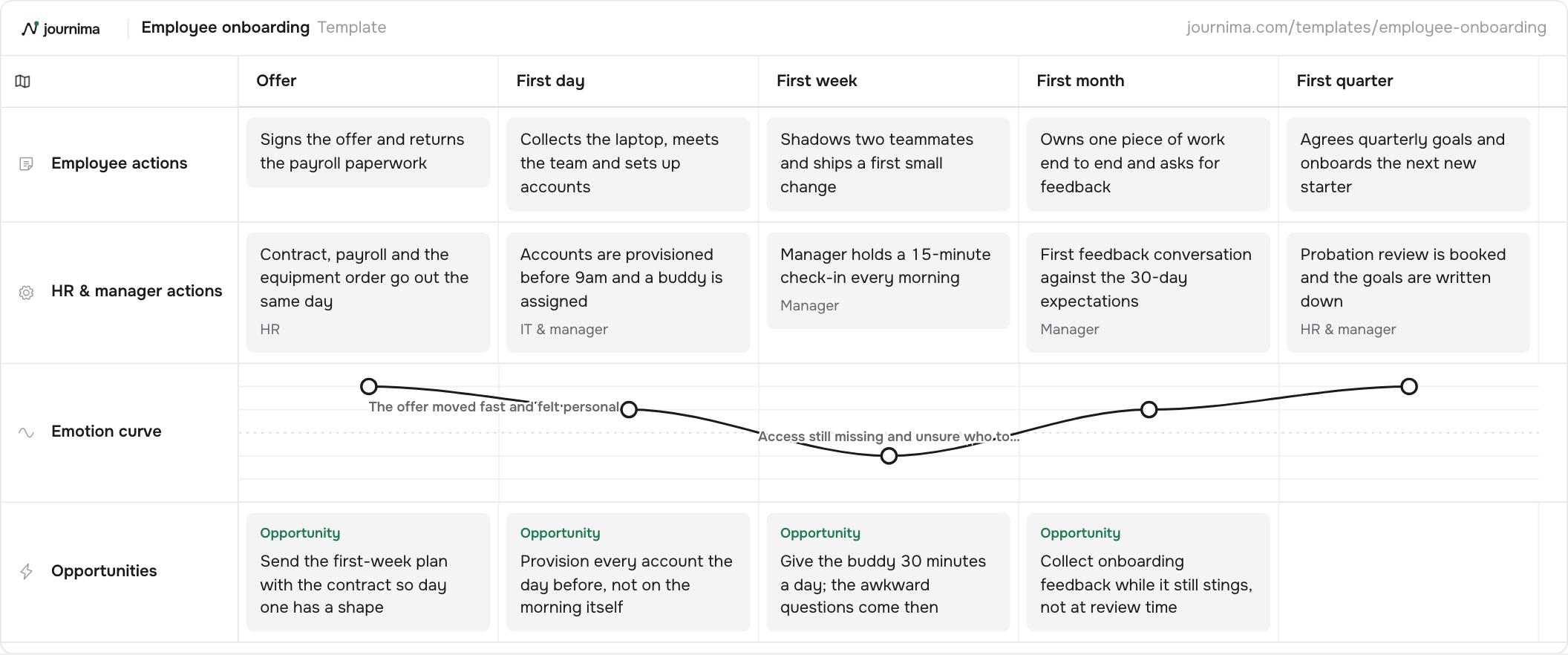
The new hire's first quarter: actions on both sides and how the experience feels.
Employee onboardingTemplate
01Offer
02First day
03First week
04First month
05First quarter
Employee actions
Collects the laptop, meets the team and sets up accounts
Shadows two teammates and ships a first small change
Owns one piece of work end to end and asks for feedback
Agrees quarterly goals and onboards the next new starter
HR & manager actions
Contract, payroll and the equipment order go out the same day
Accounts are provisioned before 9am and a buddy is assigned
Manager holds a 15-minute check-in every morning
First feedback conversation against the 30-day expectations
Probation review is booked and the goals are written down
Emotion curve
Opportunities
Opportunity
Send the first-week plan with the contract so day one has a shape
Opportunity
Provision every account the day before, not on the morning itself
Opportunity
Give the buddy 30 minutes a day; the awkward questions come then
Opportunity
Collect onboarding feedback while it still stings, not at review time
What is in the employee onboarding journey template
5 stages
- Offer
- First day
- First week
- First month
- First quarter
4 lanes
- Employee actions
- Text
- HR & manager actions
- Backstage
- Emotion curve
- Emotion curve
- Opportunities
- Pains and opportunities
When to map onboarding as a journey
Use it for the first quarter of a new hire, from offer letter to the first real win. The employee's actions sit above the HR and manager actions that make them possible, with an emotion curve for how the quarter feels. It is a journey map for people teams, and it works the same way.
The example covers one new hire's first quarter in five stages: Offer, First day, First week, First month and First quarter. The curve starts at plus two, because the offer moved fast and felt personal. It falls to minus one in the First week, when access is still missing and nobody knows who to ask.
That dip is the reason to draw the map. Onboarding is usually treated as a checklist problem, and the checklist can be complete while the new hire waits. The waiting starts with work that was queued for the first morning instead of the week before.
How to fill it in
- Set the span before the stages. Offer to first quarter works, because it ends where the new hire starts producing. A map that stops on the first day only measures the laptop.
- Write Employee actions from the hire's side. Signing, collecting, shadowing, owning one piece of work, agreeing goals. The example ends with the new starter onboarding the next one, which is a fair test of whether it worked.
- Fill HR & manager actions, with an owner on every card. It is a backstage lane, so each card carries who does it: HR, IT, the manager. In the example accounts are provisioned before nine and a buddy is assigned on the first day.
- Score the curve from what new hires said at the time. Use the questions people ask in their first month, not the probation review. The example scores plus two at the Offer, minus one in the First week and plus two by the First quarter.
- Answer each dip with an Opportunities card. The lane holds four, one per stage up to the First month. Send the first-week plan with the contract, provision accounts the day before, give the buddy thirty minutes a day.
Download the template
Download for ExcelA spreadsheet, one column per stage.
Download as PNGThe whole grid as one picture.
The Excel file opens in Excel, Numbers and Google Sheets. Fill it in, then import it into Journima when you have an account.
How to adapt it
- Add a lane per team that touches the new hire: IT, facilities, payroll.
- Mark the moments where the emotion curve dips and assign an owner.
- Reuse it for internal moves and returns from leave.
Questions about the employee onboarding journey template
Is employee onboarding really a journey map?
The machinery is the same. The traveller is the new hire, the stages are weeks rather than buying steps, and the organisation sits in the lane underneath. People teams use the method for transfers, returns from parental leave and leaving too.
How long should an onboarding map cover?
To the first piece of work the hire owns alone, which is about a quarter in most roles. Stop earlier and you are measuring admin. Run it much longer and you are measuring management rather than onboarding.
How do you get honest emotion scores from new hires?
Ask during the first month, not at the probation review. People rewrite a bad first week once it has ended well. Three questions after day one, after week one and after month one give you the curve while it is still true.
What does the map show that an onboarding checklist does not?
A checklist records what the organisation did. The map records what it was like on the other end, which is where the first-week dip lives. Employee experience teams keep both and read them together.
Keep reading
Other templates
Basic customer journey
A minimal end-to-end journey: what the customer does, where it happens, and how it feels.
4 stages · 3 lanes TextChannelsEmotion curveDetailed customer journey
A fuller journey with channels, an emotion curve, pains and opportunities, and the metrics to watch.
6 stages · 5 lanes TextChannelsEmotion curvePains and opportunitiesService blueprint
Frontstage and backstage view of one service encounter, from first contact to follow-up.
5 stages · 4 lanes TextFrontstageBackstageDay in the life
Shadow one person through a typical day to find the moments that matter.
5 stages · 4 lanes TextChannelsEmotion curvePains and opportunitiesB2B buyer journey
A buying committee's path from problem to rollout, with content touchpoints and deal metrics.
6 stages · 4 lanes TextChannelsPains and opportunitiesE-commerce purchase journey
From discovery to post-purchase: where shoppers drop off and what to measure.
6 stages · 5 lanes TextChannelsEmotion curvePains and opportunitiesSupport & complaint journey
A support case end to end: customer, front line, and what happens behind the desk.
5 stages · 5 lanes TextChannelsFrontstageBackstageEmotion curvePatient journey
A care journey from first symptoms to aftercare, tracking experience along the way.
6 stages · 4 lanes TextChannelsEmotion curvePains and opportunitiesSee your journeys take shape.
Start your free 14-day trial. No card needed.