Notices knee pain after every run and self-treats for two weeks
Patient journey template
A care journey from first symptoms to aftercare, tracking experience along the way.
Patient journeyTemplate
01Symptoms
02Appointment
03Diagnosis
04Treatment
05Recovery
06Aftercare
Patient actions
Books the first free GP slot and describes the symptoms
Has the scan, then hears the result at a follow-up visit
Starts physiotherapy and a set of exercises for home
Logs the exercises weekly and returns to short runs
Comes back for a check-up and adjusts the training plan
Touchpoints
- Web
- Web
- Phone
- Other
- Post
- Other
- App
- App
- Other
Emotion curve
Pains & opportunities
Pain
The first free slot is three weeks away, and the knee gets worse meanwhile
Pain
Nobody explains what happens between the scan and the result
Opportunity
Send the exercise plan to the phone with a weekly reminder
Opportunity
Ask about pain and activity at the check-up, not only range of motion
What is in the patient journey map template
6 stages
- Symptoms
- Appointment
- Diagnosis
- Treatment
- Recovery
- Aftercare
4 lanes
- Patient actions
- Text
- Touchpoints
- Channels
- Emotion curve
- Emotion curve
- Pains & opportunities
- Pains and opportunities
When to map a care pathway
Use it for a care pathway, from first symptoms to aftercare. Six stages, the patient's actions, the touchpoints they use, an emotion curve and the pains and opportunities at each step. It keeps the patient's experience next to the clinical path rather than in a separate report.
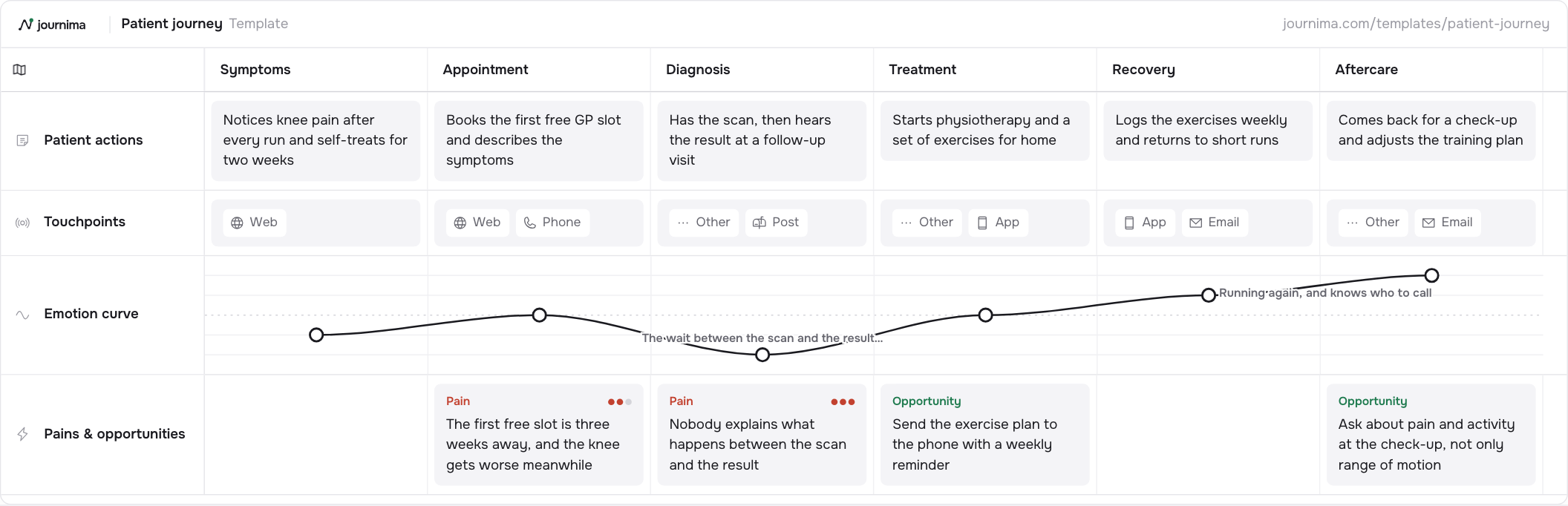
The example follows one knee injury across six stages: Symptoms, Appointment, Diagnosis, Treatment, Recovery and Aftercare. The patient self-treats for two weeks, waits three weeks for the first free slot, and scores minus two at Diagnosis. Nobody has explained what happens between the scan and the result.
Nothing in that list is a clinical failure. The scan happened, the physiotherapy worked, and by Aftercare the patient is running again and knows who to call. The map exists because the pathway and the experience are two different things, and only one of them is written down.
How to fill it in
- Map the pathway the patient walks. The example starts two weeks before the first appointment, while the knee is being self-treated. That fortnight rarely reaches a clinical record, and it sets the tone for everything after it.
- Write Patient actions in the patient's words. Noticing, booking, describing, waiting, logging exercises, coming back for a check-up. Clinical language belongs in the notes, not in this lane.
- Add the Touchpoints, including the ones on paper. The example uses the web, the phone, the post, an app and email, alongside the visits themselves. A letter is a touchpoint, and it is often the one that arrives late.
- Score the curve on the waits. The worst score here is not the diagnosis. It is the wait before it, when nobody has said what happens next. The curve reaches plus two only at Aftercare.
- Separate the pains you can fix from the ones you cannot. A three-week wait for the first free slot is capacity. Silence between the scan and the result is communication, and it is the cheaper of the two to change.
- Put the opportunities where somebody can act. The example holds two. Send the exercise plan to the phone with a weekly reminder, and ask about pain and activity at the check-up, not only range of motion.
Download the template
Download for ExcelA spreadsheet, one column per stage.
Download as PNGThe whole grid as one picture.
The Excel file opens in Excel, Numbers and Google Sheets. Fill it in, then import it into Journima when you have an account.
How to adapt it
- Add a backstage lane for clinical and administrative steps.
- Keep transcripts pseudonymised in the research hub and link evidence to cards.
- Map a carer as a second persona and compare curves.
Questions about the patient journey map template
What is a patient journey map?
It is a map of a care pathway from the patient's side: what they do, where they go, what they wait for and how each step feels. The clinical pathway records what was done. This records what it was like to receive it.
How do you map a pathway that crosses organisations?
Keep one map and treat each crossing as a stage change. The example moves from a GP appointment to a scan and then to physiotherapy. Every crossing is a place where the patient repeats their story, so each deserves its own card.
Can a patient journey map use real patient data?
Keep names and identifiers off the map. Work from pseudonymised transcripts, and reference the passage from the card instead of pasting it in. Security and privacy covers where the data sits and who can open it.
Does this work for a long-term condition?
The stages repeat instead of ending. Map one cycle: a flare, a contact, an adjustment, a period of stability. Then mark what changes on the second lap, because that is where most of a patient's life with the condition happens.
Keep reading
Other templates
Basic customer journey
A minimal end-to-end journey: what the customer does, where it happens, and how it feels.
4 stages · 3 lanes TextChannelsEmotion curveDetailed customer journey
A fuller journey with channels, an emotion curve, pains and opportunities, and the metrics to watch.
6 stages · 5 lanes TextChannelsEmotion curvePains and opportunitiesService blueprint
Frontstage and backstage view of one service encounter, from first contact to follow-up.
5 stages · 4 lanes TextFrontstageBackstageDay in the life
Shadow one person through a typical day to find the moments that matter.
5 stages · 4 lanes TextChannelsEmotion curvePains and opportunitiesEmployee onboarding
The new hire's first quarter: actions on both sides and how the experience feels.
5 stages · 4 lanes TextBackstageEmotion curvePains and opportunitiesB2B buyer journey
A buying committee's path from problem to rollout, with content touchpoints and deal metrics.
6 stages · 4 lanes TextChannelsPains and opportunitiesE-commerce purchase journey
From discovery to post-purchase: where shoppers drop off and what to measure.
6 stages · 5 lanes TextChannelsEmotion curvePains and opportunitiesSupport & complaint journey
A support case end to end: customer, front line, and what happens behind the desk.
5 stages · 5 lanes TextChannelsFrontstageBackstageEmotion curveSee your journeys take shape.
Start your free 14-day trial. No card needed.