These artefacts overlap, and the words for them are used loosely. Two teams can mean different things by experience map and both be in reasonable company. So the useful question is not which definition is correct. It is which shape answers the question you actually have.
The question usually arrives second-hand. Somebody asks for an experience map, or a designer offers a user flow, and the word arrived from somebody's last job rather than from a decision here. You find out it was the wrong shape at the end of the session rather than the start.
The short answer
Reach for a journey map when the question is what one person goes through over time with your organisation. Especially when the teams who serve that person answer it differently.
Everything else here is wider, narrower or deeper. Wider: an experience map, which takes your organisation out of the middle and follows the whole problem. Narrower: a user flow, which is one path through an interface. Deeper into the person: an empathy map, which holds what somebody said and felt with no clock on it. Sideways into delivery: a user story map, which orders what you intend to build, and a service blueprint, which shows how a moment is produced.
If the answer above is not obvious, three questions at the end of this page narrow it to one.
The six artefacts, side by side
| Artefact | Whose view | Time span | Good for | Cannot show |
|---|---|---|---|---|
| Journey map | One customer, one goal | Days to years | Agreeing where the experience breaks | How the service is produced |
| Experience map | Anyone with the problem | A whole day, or a whole problem | Finding where you are not present | What your own service does, step by step |
| User flow | The product's, not the person's | Seconds to minutes | Designing and reviewing one path | Why the person came, and how it felt |
| Empathy map | One person, one moment | No clock at all | Sharing what the research heard | Sequence, and how long anything took |
| User story map | The delivery team | The next few releases | Slicing what to build first | Emotion, channels and evidence |
| Service blueprint | The organisation, top to bottom | One encounter | Finding the cause below the line | A whole customer relationship |
Journey map or experience map?
An experience map follows a person through a whole problem without your organisation at the centre of it. Moving house. Recovering from an operation. Getting through a working day. Your service might appear in two columns out of eight, or in none.
This is where the field is loosest. Some practitioners keep the term for exactly that product-free view. For many others it is simply another word for a journey map, and a few reserve it for one that carries an emotion curve. Ask which is meant before you agree to make one.
Where it beats a journey map. When you are new to a market and have no journey to map yet. When the problem starts long before anybody thinks about buying. When you suspect the real failure sits in the gaps between providers, which no single journey map contains.
Where it fails. Its columns tend to have no owner. Point at any one of them and ask who would have to act on it. When the room cannot name anybody, you have a finding to hand over rather than one to work on.
How the two connect. The wide map tells you which slice deserves a narrow one. Draw it, pick the stretch where your service appears or should appear, and turn that stretch into a journey map carrying the same column names. The guide to customer journey stages covers what counts as a boundary.
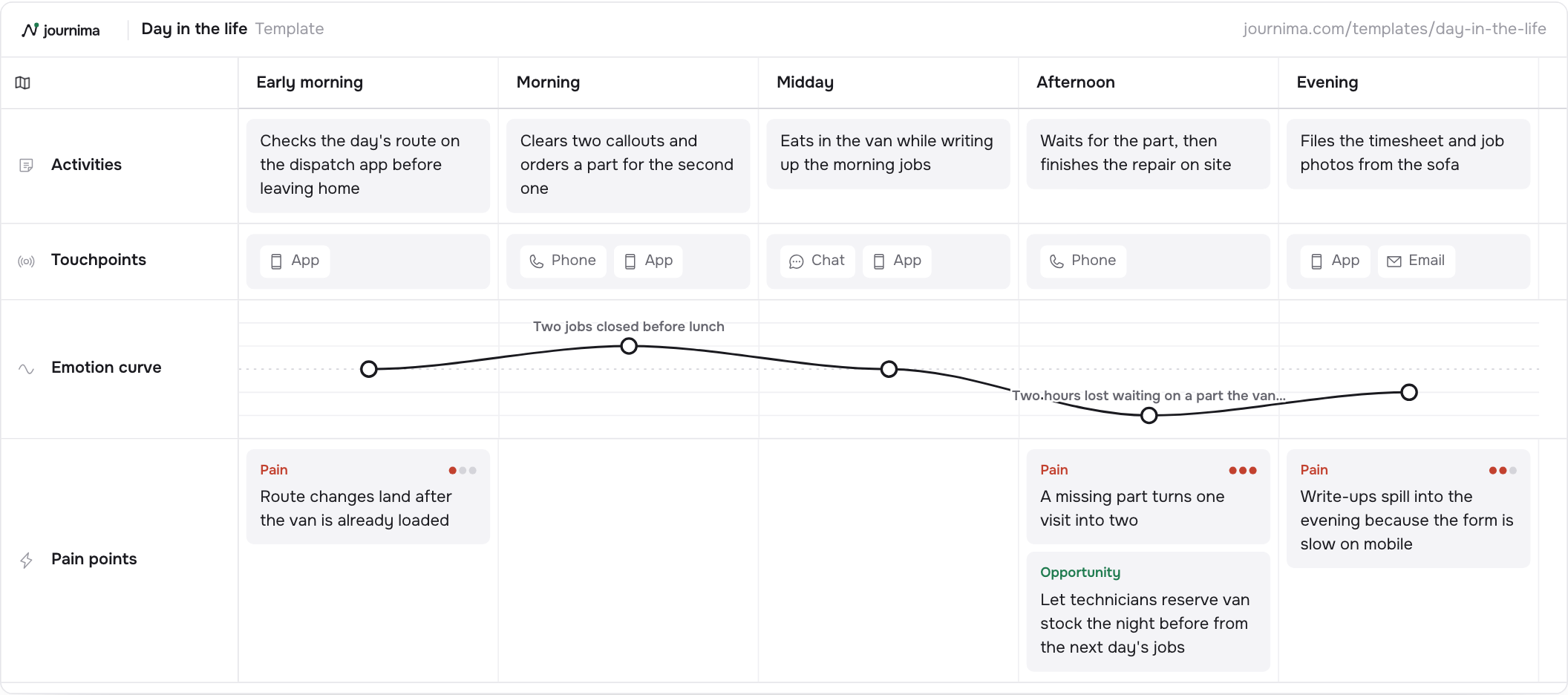
The nearest thing the starters have is the day in the life map. Its traveller is a field technician and its top lane is Activities, not Customer actions, though it still carries an Emotion curve. It maps somebody doing their job, not somebody being served. Where that curve reaches minus two, its note reads "Two hours lost waiting on a part the van should carry". No service that person was buying had failed, so a journey map drawn around your organisation would have no column for it.
Journey map or user flow?
A user flow is the path through an interface: the screens a person passes, the decisions between them, and what happens on each branch. Boxes and arrows, drawn beside the design work, usually by one or two people rather than by a room.
Where it beats a journey map. Everything after the click. Counting steps, finding dead ends, working out what happens when a code expires or a card is declined. A journey map has one card where a flow has fourteen boxes, and those fourteen boxes are the design.
Where it fails. There is no feeling in it, nothing outside your product, and no before or after. A flow can tell you the task is completable. It cannot tell you the person arrived furious because a letter had the wrong date on it.
How the two connect. One stage of a journey map produces a flow, and a dead end in that flow produces a pain card back on the map. Leave the flow where it was drawn and point at it from the cell it belongs to. An embed lane in Journima holds a prototype or a document inside a cell, so the link lives on the map itself.
Journey map or empathy map?
An empathy map holds one person at one moment, divided into quadrants. The labels vary from team to team. The common set covers what the person says, thinks, does and feels, with pains and gains sometimes added underneath. There is no clock in it. Everything on the page is true at once.
Where it beats a journey map. At the very start, when you have a pile of interview notes and no structure to hang them on. Filling one per persona makes a group separate what somebody said from what the team has inferred, and a journey map lets you blur exactly that line.
Where it fails. Any question about sequence. It cannot show that the frustration in one quadrant arrived three weeks after the request in another, and the three weeks are usually the finding.
How the two connect. Empathy maps feed the notes on a curve. When the line dips and somebody asks why, the sentence that explains it has often already been written into a quadrant. The hub's emotion curve section covers what a note has to do.
Journey map or user story map?
A user story map arranges a backlog by the user's steps. The top row runs left to right like a journey; under each step sit the things you could build for it, ordered by what ships first. Horizontal lines across the middle become releases.
It gets mistaken for a journey map because of that top row, and the mistake costs a workshop. The two rows look alike and mean opposite things. One records what happens to somebody. The other records what you have decided to do about it.
Where it beats a journey map. When the session has to end in a plan. A story map finishes with a line drawn across it and a release on either side, which is a decision a journey map is not built to make.
Where it fails. As evidence. It records intent, so it cannot tell you whether the customer minds. Emotion, channels and research have nowhere to sit in it.
How the two connect. Run the journey map first and let the story map borrow its column names, so the plan is filed under the customer's words rather than your team's. The pains on the map become the slices worth arguing over.
Where a service blueprint fits
The sixth row of the table is the service blueprint, and this page does not explain it. Two pages here already do. Journey map or service blueprint is the short version; how to create a service blueprint is the long one.
Three questions that pick one
Ask them in this order, and stop at the first one that gives a single answer.
- Whose view has to be on the page? One customer's: a journey map, or an experience map when your organisation is not the point. The organisation's: a blueprint. The delivery team's: a story map. One person's inner life: an empathy map.
- How long is the span? Seconds and clicks: a user flow. One errand or one encounter: a blueprint, or a narrow journey map. Months or years: a journey map. A whole day or a whole problem: an experience map.
- What has to exist when the session ends? Agreement: a journey map. A design: a user flow. A release plan: a story map. A shared picture of one person: an empathy map. Failure points with owners: a blueprint.
Where two answers survive all three questions, make the narrow one. It is quicker and it is easier to be wrong in public with. The wide one is easier to draw afterwards, because by then you know what belongs in it.
If all three questions come back blank, none of these is what you need. The room does not know the person well enough to draw any of them. Spend a day with somebody who has the problem, then ask again.
Two starters cover both ends of this page. The detailed customer journey is a journey map at full size: six columns, five lanes, one software buyer. The day in the life is the other end. It follows a person through a day rather than a purchase through a funnel, and that person is the one doing the serving. Customer journey map examples reads five more starters, and the day in the life a second way.
If the answer is a journey map, start with how to create a customer journey map. When it has to happen in a room this week, the half-day workshop agenda is the timetable.
Whichever one you choose, write the question it has to answer along the top of it. Then anyone who reopens it can see in one line what it was supposed to settle.