A journey mapping workshop is a room of people who each hold a quarter of the same story. Your job is not to know the journey. It is to get what they know onto one surface before the energy goes.
Half a day is the right size: three and a half hours, one break, one map. The method underneath it is set out in how to create a customer journey map, and the hub's five-line version is shorter still. Neither tells you what to do at 2:20, when the room has spent ten minutes arguing whether a column is minus one or minus two.
What has to be true before you book the room
Three things, and none of them is the map.
- A scenario that fits in one sentence. Write it, then read it back to whoever asked for the workshop. If their version differs from yours, you have found the meeting to hold instead. The first of the seven steps says what belongs in that sentence.
- Evidence in the room, unread. Recent tickets, a handful of interview notes, last quarter's survey. It is there so that when the room invents a dip, somebody can check it within the hour.
- A decision that is waiting for the map. Name it in the invitation. If nobody can name one, you are booking a good afternoon rather than a piece of work.
Evidence already worked up into findings is worse than none: it settles the argument before the room has had it. What you attach afterwards is the hub's evidence section. Still choosing the journey? Customer journey map examples for six industries is the page for that.
Who to invite, and who to leave out
Eight is a room. Twelve is an audience, and an audience waits to be shown something.
Count the eight out before the invitation goes. Three who hear the complaint first and can quote yesterday's from memory. One who can change something without asking permission. One who can test a claim against real data the same week. One sceptic, invited on purpose. You, and whoever holds the keyboard.
The sceptic is not a courtesy. If the room agrees all afternoon, it has drawn the map it already believed. That one voice is how you find out on the day rather than next month.
Leave out anyone coming to watch. Before you send an invitation, ask whether the team whose work will take the dip would say so with that person in the room. Give them a half-hour readout the week after.
Name the person holding the keyboard in the invitation and give them nothing else to do. Facilitating and typing at once produces a map in one person's handwriting.
The half-day agenda, hour by hour
Three and a half hours, from a cold start to names against findings. The clock below starts at zero. Shift it to your own start time and keep the lengths.
0:00 to 0:15, read the scenario aloud
Say the sentence you wrote, then ask one question: is anybody here mapping a different journey? Fifteen minutes is enough, and finding out at 3:00 is too late.
Then say out loud how the session ends: a name and a date against three findings. A room that can see the finish line paces itself.
0:15 to 0:35, let them rewrite your stages
The draft columns are already on the canvas. Hand the pen over and let people rename, merge and split them.
Twenty minutes, and say the number before you start. It expands to fill whatever you give it, because it is the argument everybody can join without knowing anything.
Accept every rename. Refuse the second rename of the same column: park the rejected word and carry on.
0:35 to 1:15, actions all the way across
Forty minutes on one lane. Open each stage with three minutes of silent writing before anybody speaks, so the quickest talker does not set the frame.
Your only job in this stretch is the tense. When a card arrives in the company's voice, hand it back and ask what the customer was doing then.
Stop at 1:15 whether the last column is full or not. A thin final stage is honest; a rushed one is fiction.
1:15 to 1:40, the channels they actually used
Twenty-five minutes on touchpoints, and the room speeds up here after the hour before it. Take cards as fast as they come and adjudicate nothing.
The risk here is the clock, not the lane. A crowded column reopens the stage argument at 1:30, when there is none to spare. Say the word parked, write it down, keep going.
1:40 to 1:55, break, and leave the map up
Fifteen minutes, and do not fill them with a summary.
Leave the map on the wall and leave the room yourself. The quietest three in the session tend to come back with the corrections they did not want to interrupt for.
1:55 to 2:25, score the curve, then let them argue
Thirty minutes. Ask for a score against the column before rather than an absolute number: better, worse, or the same as that one.
Take one person's scores for the whole row first, then open it up. Objecting to a line is easier than producing one, and a room objecting is a room talking.
Guard the last ten minutes. If one column's exact score is still being argued at 2:15, call it and move on; the pains need the rest of the session. The post on curves people believe covers the scale and the evidence.
2:25 to 3:00, name what hurts, one moment each
Thirty-five minutes, and the most valuable stretch. Work column by column, asking the same question in the same words each time, so the room learns what a usable answer sounds like.
Two rules, said before you start. No card names a person or a team; the moment one does, you lose the half of the room whose work is on the board. Anything phrased as we should waits on the parked list.
Ask for the evidence as you go. Each card takes one of three marks: watched, heard from a customer, or believed by somebody here. The third is allowed, and it has to be labelled.
3:00 to 3:30, owners, evidence and a date
This half hour has one enemy: the urge to make the canvas look finished. Say at 3:00 that nothing is being tidied today.
Run it as a round, not a discussion. Read the three worst findings out one at a time, then wait. Whoever speaks first owns that one, and you write the name down while they are still talking.
If nobody speaks, name somebody yourself and let them refuse. What the room owes each finding is in the closing step of guide one. Then book the next session before anybody stands up.
Facilitation moves for when it goes wrong
Three moments come up often enough to prepare for.
- One voice is taking the room. Do not ask them to leave space for others. Change the format: three minutes of silent writing, then read the cards out yourself with no names attached. If it carries on, give that person a job that needs listening.
- The room is stuck on a stage name. Give it four minutes on a visible timer, then write both names on the column and move on. An argument that outlives four minutes is usually about the scenario sentence, not about the word.
- Nobody will score the emotion lane. Find out which kind of silence it is. Ask one person to describe the column in a word rather than a number. If a word comes, the scale was the obstacle. If nothing comes, an admitted blank beats an invented score.
Read the parked list back at the break. A visible list closes an argument without anyone feeling cut off.
What to bring, and what to put on the canvas first
Prepare the canvas the evening before. Open the basic customer journey starter, write your scenario sentence across the top, and delete every example card.
The starter gives you four columns and three lanes, which is as much as a first session can actually fill. Its column names are Awareness, Consideration, Purchase and Retention. Those are funnel words; leave them unless yours are better, because step two rewrites whichever four go in. Customer journey stages explained settles the argument they have about them.
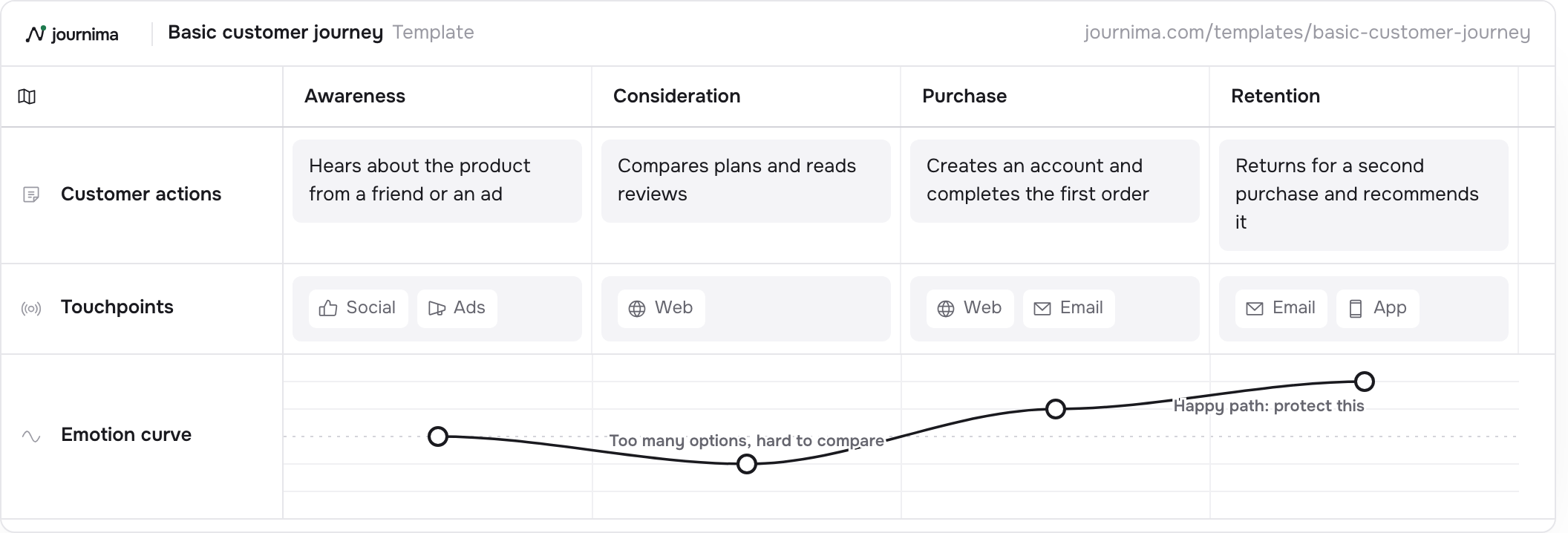
Bring four other things. A timer the room can see. The evidence in a pile. Sticky notes, even for a digital map. A printed copy of the scenario sentence.
Basic customer journey template 4 stages · 3 lanes Open the template and download itThe starter's page carries a spreadsheet and a picture of it, so a room with no software can run this off a printout. Editing it in Journima needs an invitation to a workspace.
Remote, or in the room
The agenda holds on a call. Three things change.
First, the length. Split it at the break: the first sitting runs an hour and forty minutes, the second picks up at the curve and runs an hour and thirty-five. Leave a day between the two sittings.
Second, the silence. In a room you can read a pause. On a call a pause is indistinguishable from a bad connection, so ask people by name and wait longer than feels polite.
Third, the surface. Everybody on their own screen, never one camera pointed at a wall, and one person holding the canvas. You then have nothing to copy off photographs on Monday.
What a call takes away is the break. Leave the map open overnight for comments instead.
The week after the workshop
The session ends at 3:30. What the map is worth gets decided in the five days after that.
Write the summary yourself the same afternoon, while you still remember why a card is worded the way it is. Six lines in an email, never an attachment. The post on maps that die in a slide deck is what an attachment becomes.
Then let the argument carry on where the map is. A comment on the card keeps the objection beside the thing it objects to, and Journima logs what changed.
Then three jobs, in the order they decay.
- Rank the three findings by weight, not by volume. The loudest person in the session is not a ranking. Take the ones with the widest reach.
- Put one person against each of the three. Twenty tickets or four conversations usually settles whether the room was right. The people a stage depends on but the customer does not meet were not in this room; putting them in one is how to create a service blueprint.
- Fix the date the map is opened again. Use a meeting that already exists rather than inventing one. What to do once it is open is the hub on keeping a map alive.
One last job, for you rather than the map. Write down what went wrong while it is fresh: where the agenda ran long, which question fell flat, who was missing.
Can we split this into two stages? Procurement is its own journey.
Agreed, drafting it in the B2B map. Linking it here.