What you are about to make is a grid. What you leave with is a numbered list of the points where the service lets the customer down. That list is the part anyone acts on.
It takes one session and three kinds of person. The first step below names them, and says what happens when the third cannot come.
When a blueprint is the right tool
The post on journey map or service blueprint says you will know the moment when it arrives. The hub guide's section on choosing covers the difference between the two. If you would rather not wait to recognise the moment, three things on a map you already have say it out loud.
- A number on the journey map that nobody can break down. Three days is not a step. It is a queue with an unknown number of stages inside it, and a blueprint is how you count them.
- A handover that keeps dropping things. Information reaches the second team incomplete, and the customer pays for it by repeating themselves.
- A fix that will not stay fixed. The frontstage has been redesigned twice and the complaint has not moved, which means the cause was never on the page.
If none of them is showing, the journey map is still the right artefact, for the reason the post gives.
The anatomy: four lanes and two lines
Distance from the customer sets the order, nearest at the top.
- Customer actions. One card per stage, in the customer's order, naming what they did and nothing else.
- Frontstage. What they meet, and who or what delivers it. Each card carries an actor.
- Backstage. The work that produces the frontstage and stays out of sight. Each card carries an owner.
- Supporting processes. The machinery a stage leans on that is not a person: software, schedules, published rules.
The figure above draws one of the two lines, the line of visibility. It sits under Frontstage: above it everything is available to the customer, below it the work happens whether they notice or not. The other line, the line of interaction, would sit one row higher, between the patient's row and the frontstage row. Every crossing of it is a moment the service and the person touch.
In Journima both lines are drawn with a divider lane. Frontstage and backstage are lane types in their own right, rather than ordinary cards under a heading. The actor and the owner are fields on the card rather than words inside it.
Drawing a service blueprint, step by step
One lane all the way across, then the next one down. The journey map guide gives the general reason for working that way. A blueprint adds a second reason of its own: its lanes are not parallel. A backstage card exists because of the frontstage card above it. Fill one column top to bottom in a single sitting and you invent the layers you have not met yet.
Fix the encounter and its two ends
A blueprint covers one encounter. Write its start and end on the wall before anybody opens the tool, and be strict about both.
The end is where teams lose the argument. The workshop will tell you a repair ends when the customer rides away. Choose that end and the reminder months later belongs to nobody, which is usually how it came to be forgotten. Pick the longer span once, at the start, or you will redraw the grid.
That is the opposite of narrowing a journey map's scope, and the two do not conflict. A journey map narrows how much of a life you take on. Here the width is already fixed at one encounter, so the only question left is where it stops.
Get three kinds of person in the room: somebody who faces the customer, somebody who does the work behind them, and somebody who keeps the systems running. If the last of those cannot come, the bottom lane fills up with names people half remember.
Fill Customer actions, and keep it thin
The top lane is the same lane a journey map opens with, and it stays short here. One action per stage, written from the customer's side, with no explanation of how it is delivered.
Thin is the point. This is the only row a customer could confirm for you. Anything you smuggle into it stops being checkable by the one person who was there. A card reading agrees the quote is a customer action. Receives quote from mechanic after stock check is three lanes in a trench coat.
Frontstage: who the customer is dealing with
Go back to the first stage and ask what the customer actually met there. Then put who or what delivered it in the actor field, whether that is a named team, a shopfront or a piece of software.
The naming is not admin. A card whose actor nobody can supply is either a step that happens by accident or one two teams each assume the other covers. Either way you have found something before the backstage lane is open.
Backstage: cross the line and slow down
This is the lane the session was called for, and it is where the room goes quiet, because the cards describe the people in it.
Ask what has to be true for the frontstage card above to happen at all, then give the answer an owner. Where two owners meet on one card, write down how long the gap usually runs. A grid that records who does what and never how long it takes will send you to the wrong card.
Write what happens, not what is supposed to happen. A backstage lane copied from the process documentation comes out neat, complete and wrong.
Supporting processes: use the system's real name
The bottom lane names what a stage leans on to work at all. In the bike repair it is a booking system, a workshop tablet, a parts catalogue, a till and a CRM. Use the name people say out loud, not the one in the procurement contract.
It looks like the dullest lane and it decides the price of every fix you are about to propose. Changing a rota is an afternoon. Changing the system under it is a quarter and a business case. This row tells you which one you are asking for before you promise anybody a date.
Walk the grid for failure points
Now read the finished grid aloud, one stage at a time, top to bottom, with the people who do the work. Reading down is what the artefact is for.
Flag every point where a card depends on something that is late, manual or owned by nobody. Everything else in the grid is context for that list. Number them before anyone leaves the room. A failure point is usually a relationship rather than a card, so put the number on the lower of the two and name the card above it. A marker and a numbered list are enough for the first week. When one of them turns out to be a standing problem, it earns a portfolio item, which is where Journima's keys and scores live.
A service blueprint example: a same-day bike repair
Aware, Enter, Engage, Exit and Follow-up: five stages, four lanes, one bicycle. The encounter starts before the shop knows the customer exists and ends after the bike has gone home.
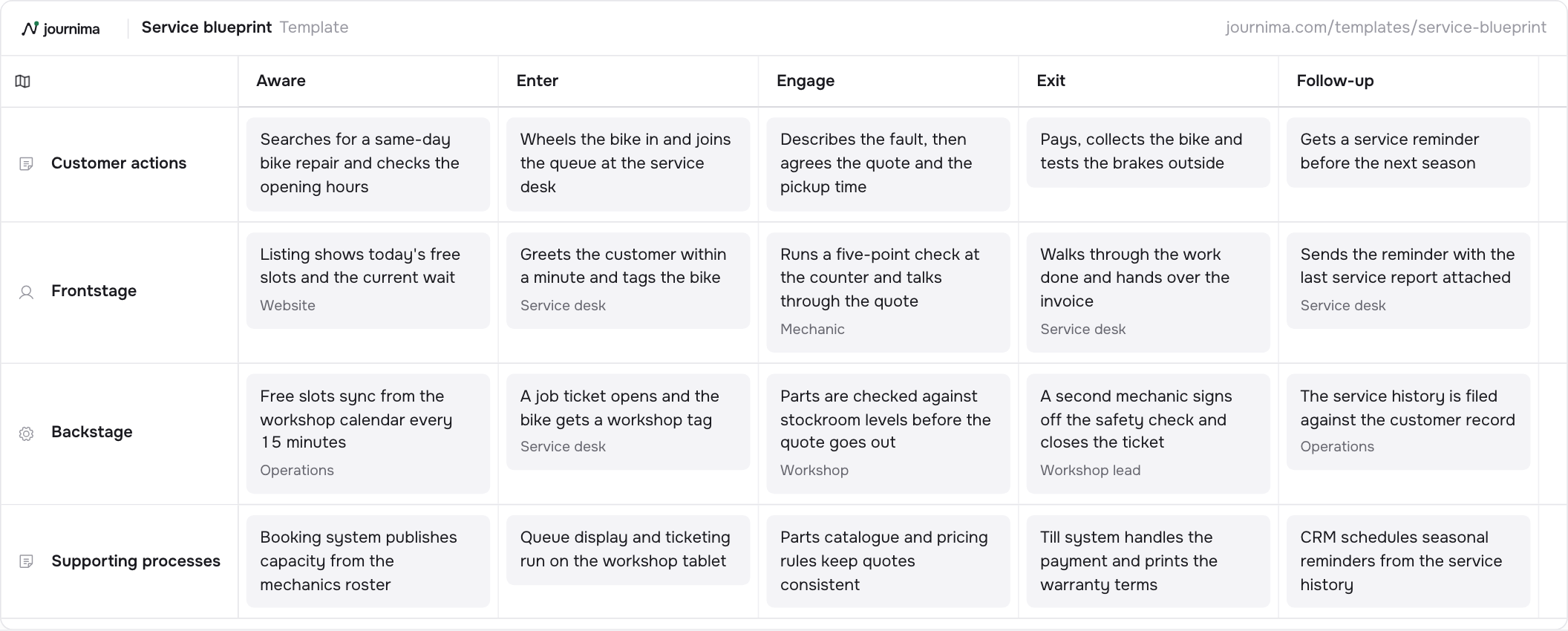
Reading across gives you the story. Reading down one stage gives you the machinery. Take Engage, the middle column, top to bottom.
Customer actions has "Describes the fault, then agrees the quote and the pickup time". That is the whole of the customer's experience of this stage: a conversation and a number they say yes to.
Frontstage, with the mechanic as the actor, has "Runs a five-point check at the counter and talks through the quote". The check is in front of the customer on purpose. A quote explained while the wheel is being spun is a different object from one sent by email.
Backstage, owned by the workshop, has "Parts are checked against stockroom levels before the quote goes out". Nobody at the counter sees this, and the same-day promise lives or dies on it.
Supporting processes has "Parts catalogue and pricing rules keep quotes consistent". That is what stops two mechanics quoting two prices for the same repair.
Four cards, one chain. The quote is only as good as the stock figure behind it, and the stock figure is only as good as the catalogue under that. When a customer says the price changed, the blueprint turns a complaint into a question with an address.
What to do with the finished blueprint
Three things, in the fortnight after, or the grid becomes wallpaper.
First, hold the owners. Every backstage card has a name against it, so the blueprint doubles as a list of who to ask. Read it at the next operations meeting rather than presenting it once to a steering group.
Second, put a number against the three worst gaps before anybody argues about fixes. A handover people call slow is a debate. A handover measured at two days is a decision, and one person with a week of tickets can usually get close enough.
Third, book the second reading, with whoever could not come. A blueprint drawn in one session records what that room believed, and the people who were missing tend to correct it in ten minutes. Only then are the failure points worth keys in the portfolio and worth nesting under the journey stage that sent you here, which service blueprints in Journima covers.
Service blueprint template 5 stages · 4 lanes Open the template and download itIf you are starting from nothing, take the starter, delete its cards and keep its four lanes. Your own encounter will not run Aware to Follow-up. It will have about five stages of its own, and the same four lanes underneath them.
And if the journey above it does not exist yet, draw that one first. The step-by-step guide to a customer journey map covers the two hours it takes. Customer journey map examples for six industries walks six starters, one per industry, and says which to adapt where none fits.