A journey map is worth making when people who work on the same customer cannot agree on what that customer goes through. The map settles it by putting one person's experience in front of everybody at once.
What follows is the method in seven steps, for a first serious map: one team, one scenario, a couple of hours. If you want the theory first, the hub guide covers what a journey map is. This page is about making one.
What you need before you start
Less than most teams think, and none of it is a tool.
- One scenario somebody is losing sleep over. A renewal that keeps failing, an onboarding nobody finishes, a complaint route that takes three weeks. Map the journey that is costing someone something.
- The people who hear the customer. Support, sales, the team that answers the phone. They will correct the room faster than any deck of findings.
- Two hours and one surface everybody can see. A wall or a shared canvas, either works, as long as everyone can point at the same thing.
You do not need finished personas, a research budget or a decision about software. A first map is a written-down version of what the room believes. Checking it against real evidence comes next, and the hub guide's section on evidence covers that part.
The seven steps
The hub guide has the same sequence as a short workshop agenda. This is the long version, with the reasons.
Agree the scope, and write it down
Before anybody touches a card, write one sentence at the top of the map. Who is travelling, what they want, where the journey starts and where it ends.
The two ends matter more than people expect. Buying insurance is three different maps depending on whether it begins at the first advert or at the quote form. Pick the narrow one. You can widen it later, and a map that stops at the sale will never explain why people leave in month three.
One persona and one scenario for a first map. If two groups clearly travel differently, that is two maps, or one map with two curves: how many personas a map can carry is its own question.
Draft the stages before the room fills
Stages are the columns, the phases the customer moves through. Draft five to seven of them yourself, an hour before the session, and bring them in as a proposal rather than a decision.
This feels like cheating. It is not. A room given a blank canvas spends its first hour naming columns, which is the least valuable argument on offer. A room given a draft spends ten minutes correcting it and then gets on with the content.
Use the customer's words. Waiting to hear back is a stage. Lead nurture is a department.
Write what the customer does
Fill the first lane all the way across before you open a second one. One or two cards per stage, each an action the customer would recognise as theirs.
Write from their side of the counter. Receives the renewal notice belongs to them. We send the renewal notice belongs to you, and a map written from the company's side will confirm everything the company already believes.
Finishing a whole stage before moving right feels quicker. It is not. The last column ends up written by a tired room applying looser standards than the first.
Mark where each moment happens
The second lane is touchpoints: the channels in use at each stage. The web, an email, a phone call, the app, a shop, a letter.
Keep it to the ones the customer would name. Two per stage is usually enough. A stage that needs a long list is generally hiding a second stage inside itself, and splitting it makes every lane below easier to fill.
This lane earns its place at handover. Ownership in most organisations follows the channel, so the touchpoint row tells you who has to be in the room when a fix is agreed.
Score how it feels, then explain the turns
The emotion lane is one line running across the stages. Score each of them, then annotate only the stages where the line turns.
Journima's default scale runs from minus two to plus two, with one to five and zero to ten also available. Coarse is better in a workshop. What you want out of this lane is the shape of the line, not the precision of any single point.
The notes are what survive the meeting. A score on its own tells a stakeholder nothing. A score with one sentence under it explaining the drop is something they can act on. There is more in the post on drawing curves people believe and in the hub guide's section on the emotion curve.
Mark what hurts, and give it a key
Now go back across the map and mark the moments that break. A pain point is one sentence about one moment, not a category. Three screens before the price appears is a pain point. Poor user experience is a mood.
Give each one a key. In Journima the keys live on portfolio items rather than on map cards. Create the item and it takes a key like PAT-4, unique across the workspace, and a portfolio lane can then place that item on a map. On paper, number them yourself. Ranking what you find is a step of its own in the hub guide.
Keys sound bureaucratic until the second meeting. Without one, somebody says the thing with the form and three people picture three different forms.
Decide what happens on Monday
The last twenty minutes are the ones that decide whether the map survives. Do not spend them tidying.
Agree three things. Who owns each pain point, what evidence would settle it, and when the room looks at the map again. A finding with nobody's name against it is a finding nobody checks.
Then put the map where people already are, and send a link to the live map rather than an export. An export is out of date the first time somebody moves a card. Keeping a map alive covers the habits, and why most maps die in a slide deck covers what happens without them.
A worked look at the basic template
Here is the whole method at its smallest. The starter below is four stages wide and three lanes deep, which is about as little as a useful map gets.
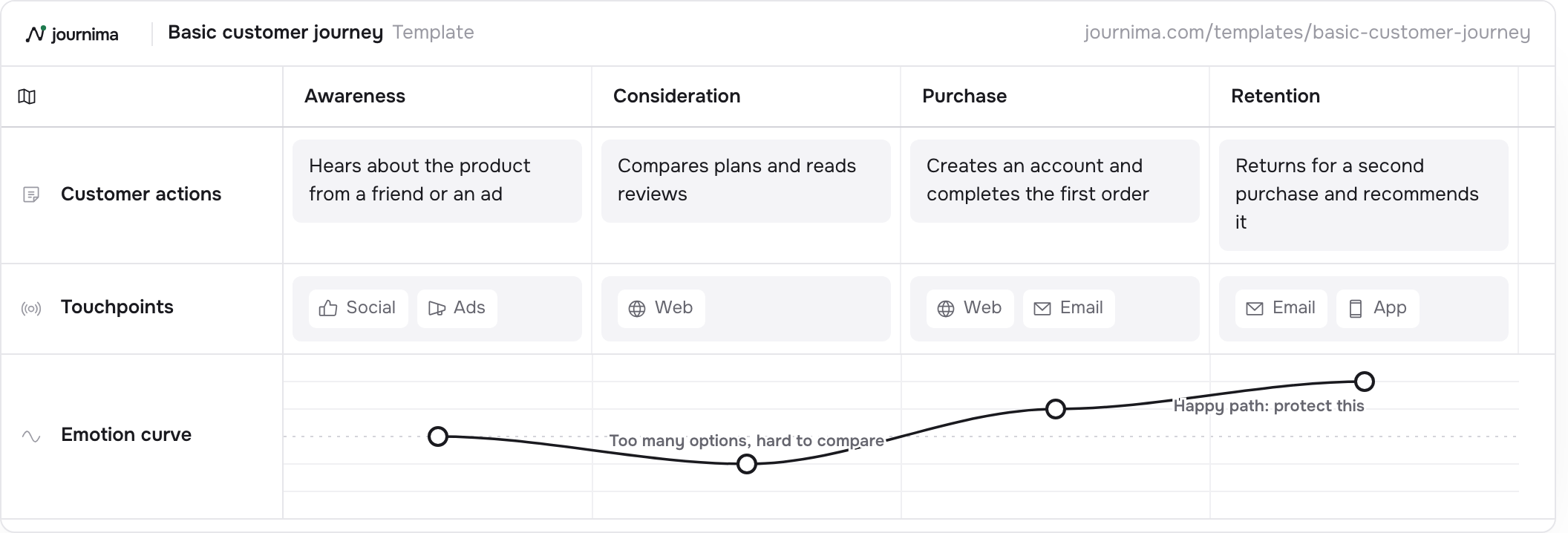
Read it downwards. The stages are Awareness, Consideration, Purchase and Retention. Customer actions runs underneath them. The customer hears about the product from a friend or an advert, compares plans and reads reviews, then creates an account and completes a first order. The last card has them returning for a second purchase and recommending it. Touchpoints marks where each of those happens, from social and advertising at Awareness to email and the app at Retention.
The curve at the bottom is the part worth copying. It sits at zero to begin with, drops to minus one at Consideration, recovers to plus one at Purchase and ends at plus two. Only two of those four points carry a note: "Too many options, hard to compare" at the dip, and "Happy path: protect this" at the end. Annotate the turns and leave the flat parts alone.
There is no pain lane here, and that is deliberate. With three lanes the dip is the finding, so the room leaves with one stage to investigate instead of a list of twelve. When that stops being enough, the detailed customer journey template adds a Pains & opportunities lane, and a number to watch under every stage.
Basic customer journey template 4 stages · 3 lanes Open the template and download itWhere first maps go wrong
Most first maps that never get opened a second time fail in one of four ways.
The other two are quieter. A map with twelve stages is two maps that have not been separated yet, and it will never fit on a screen anybody presents from. And a map that leaves the workshop with no name against any finding is a photograph of an afternoon. The hub guide lists the rest of the usual mistakes.
What to do next
Make the first map quickly and badly. Four stages and three lanes, drawn in two hours from what the room already knows, beats a perfect map a month from now. It gives everybody something specific to disagree with, and the disagreement is what sends people looking for evidence. Two hours suits a working team; a full room needs the half-day workshop agenda, and customer journey stages explained takes step two on its own.
Then do three things in the week after. Check the dip against real tickets or interviews. Put one number the team already reports under the stage it measures. Send a link rather than a picture, so the next person who looks sees the current version.
If you would rather not start from a blank canvas, fill in the basic customer journey template and bring it to the session. The map a room argues over is the one that gets used afterwards.